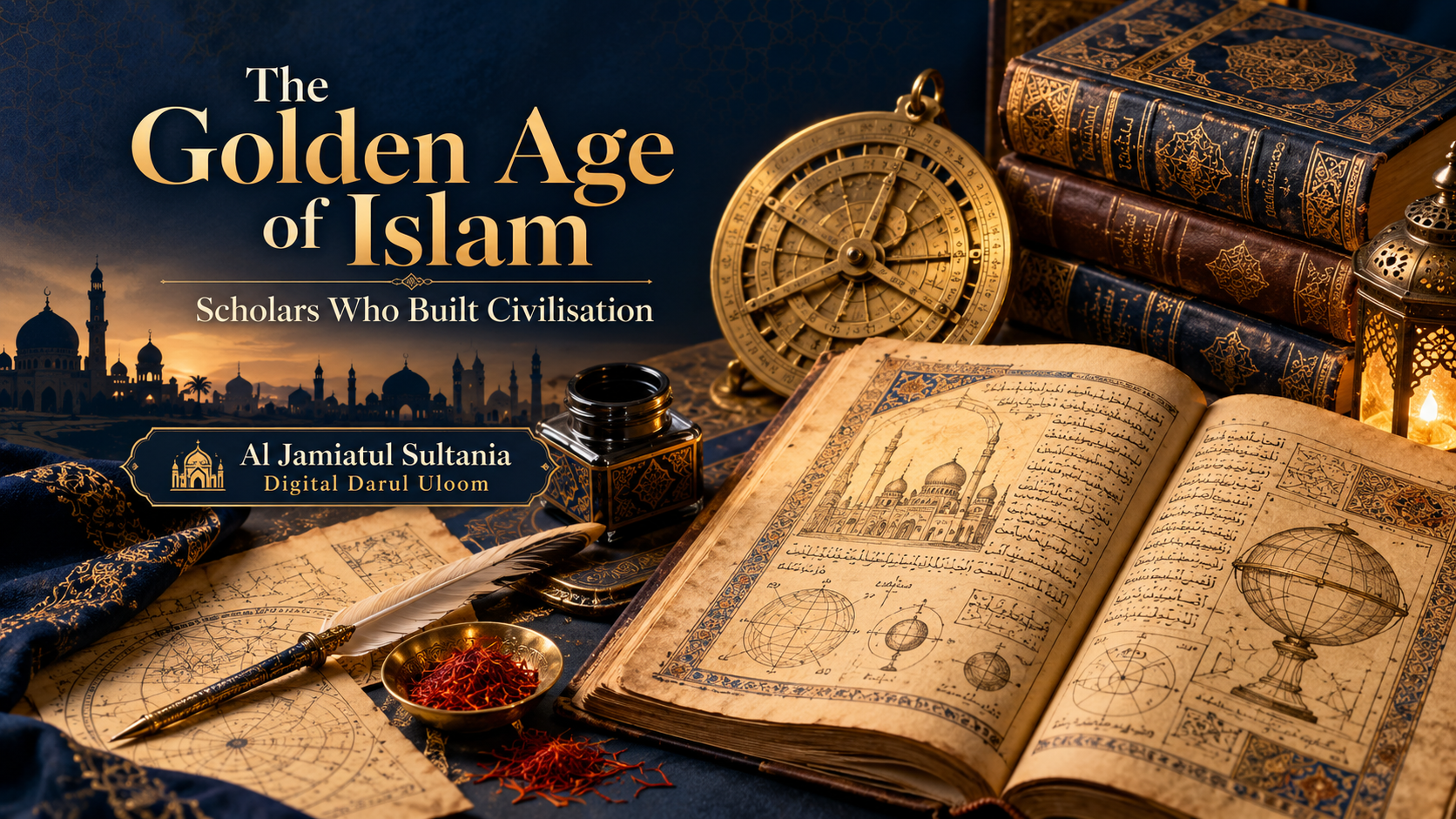
The Golden Age of Islam — Scholars Who Built Civilisation
Wishlist Share

About Course

From Baghdad’s House of Wisdom to Cordoba’s Great Library — meet the Muslim scholars whose discoveries built the modern world.

وَقُل رَّبِّ زِدْنِي عِلْمًا

“My Lord — increase me in knowledge.” — Surah Ta-Ha 20:114

While Europe endured its Dark Ages, a civilisation stretching from Baghdad to Cordoba was translating, inventing, and discovering at a pace unmatched in human history. This was not an accident of history — it was the direct fruit of a Quranic command: Iqra. Read.

THE HOUSE OF WISDOM:

In 9th century Baghdad, Caliph Al-Ma’mun built Bayt al-Hikma — the House of Wisdom — a research academy where Muslim, Christian, and Jewish scholars translated Greek, Persian and Indian knowledge into Arabic, then advanced it. It was here that Muhammad ibn Musa Al-Khwarizmi invented algebra — the word itself comes from his book’s title, Al-Jabr.

THE GREAT LIBRARY OF CORDOBA:

Meanwhile in Al-Andalus, the Great Library of Cordoba held an estimated 400,000 manuscripts — more than all of Europe’s libraries combined. It was here that Ibn Rushd’s commentaries on Aristotle would later spark the European Renaissance, and where Muslims, Jews, and Christians studied side by side in a model of coexistence historians call the Convivencia.

THIS COURSE INTRODUCES YOU TO:

The scholars who built algebra, modern surgery, optics, the scientific method, and Islamic philosophy — and the Sufi poet whose verses on divine love still outsell every other poet in America today.

8 MODULES — FROM BAGHDAD TO CORDOBA:

  • Module 1: The House of Wisdom — Foundations of a Golden Age
  • Module 2: Al-Khwarizmi — The Father of Algebra
  • Module 3: Ibn Sina — The Prince of Physicians
  • Module 4: Al-Biruni and Ibn al-Haytham — Masters of Observation
  • Module 5: Al-Ghazali — The Proof of Islam
  • Module 6: Ibn Rushd and Cordoba — Philosophy and Convivencia
  • Module 7: Jalaluddin Rumi — The Path of the Heart
  • Module 8: Ibn Battuta and the Living Legacy — Your Action Plan

32 LESSONS | 18 HOURS | FREE FOREVER | CERTIFICATE INCLUDED


Please follow and like us:
Show More

What Will You Learn?

  • ✦ How Baghdad's House of Wisdom became history's first great research academy — and why it was built on a Quranic command ✦ How Al-Khwarizmi invented algebra — and how his name became the word "algorithm" ✦ How Ibn Sina's Canon of Medicine was used in European universities for 600 years ✦ How Ibn al-Haytham invented the scientific method centuries before Francis Bacon ✦ How Al-Ghazali's crisis of doubt produced Islam's greatest work of spiritual psychology ✦ How Ibn Rushd's commentaries on Aristotle sparked the European Renaissance ✦ How Cordoba's Convivencia modelled interfaith coexistence through shared scholarship ✦ How Rumi's poetry of divine love became the best-selling poetry in America today ✦ How Ibn Battuta travelled 75,000 miles connecting the Ummah across three continents ✦ How to trace a direct historical line from Baghdad and Cordoba to the modern university, hospital, and scientific method ✦ Al Jamiatul Sultania Certificate in Islamic Intellectual History

Course Content

THIS COURSE INTRODUCES YOU TO:
Algebra. Modern surgery. The camera. The university itself. All born from the minds of Muslim scholars during Islam's Golden Age. 8 modules journeying from Baghdad's House of Wisdom to Cordoba's Great Library — meet Al-Khwarizmi, Ibn Sina, Al-Ghazali, Ibn Rushd, Rumi and Ibn Battuta. Free forever.

  • 8 MODULES — FROM BAGHDAD TO CORDOBA:

Module 1 — The House of Wisdom: Foundations of a Golden Age
How the Quranic command "Iqra" became a civilisational translation and research project. The founding of Bayt al-Hikma under Al-Ma'mun, its multi-faith scholarly community, and how it transformed Greek, Persian and Indian knowledge into the foundation of modern science.

Module 2 — Al-Khwarizmi: The Father of Algebra
The mathematician whose book Al-Jabr wa'l-Muqabala gave algebra its name, and whose Latinised name — Algoritmi — gave us the word "algorithm." His mathematics, his astronomy, and his lasting influence on computing itself.

Module 3 — Ibn Sina: The Prince of Physicians
The philosopher-physician whose Canon of Medicine was the standard medical textbook in European universities for 600 years. His systematic approach to diagnosis, his philosophy of the soul, and his encyclopaedic genius.

Module 4 — Al-Biruni and Ibn al-Haytham: Masters of Observation
Two scholars who insisted knowledge must be tested, not assumed. Ibn al-Haytham's Book of Optics and the invention of the scientific method. Al-Biruni's precise measurement of Earth's circumference and his comparative study of world religions.

Module 5 — Al-Ghazali: The Proof of Islam
The theologian whose personal crisis of doubt produced the Ihya Ulum al-Din — Islam's greatest synthesis of law, philosophy and spirituality. How honest doubt led to the deepest certainty.

Module 6 — Ibn Rushd and Cordoba: Philosophy and Convivencia
The Great Library of Cordoba, the coexistence of Muslim, Jewish and Christian scholars, and Ibn Rushd's commentaries on Aristotle that would ignite the European Renaissance centuries later.

Module 7 — Jalaluddin Rumi: The Path of the Heart
The Sufi poet whose Masnavi remains one of the most-read works of spiritual literature in the world. His path from scholar to mystic, and his enduring message of divine love.

Module 8 — Ibn Battuta and the Living Legacy: Your Action Plan
The traveller who connected the Ummah across 75,000 miles and three continents. Tracing the Golden Age's direct legacy into the modern university, hospital and scientific method — and building your own plan to carry this tradition forward.

Student Ratings & Reviews

No Review Yet
No Review Yet
✉ aljamiatulsultania.edu@gmail.com | 📍 Global
Student Registration |
🌐 EN اردو عربي