aljamiatulsultania.edu@gmail.com | 📍 Global
Student Registration |
🌐 EN اردو عربی

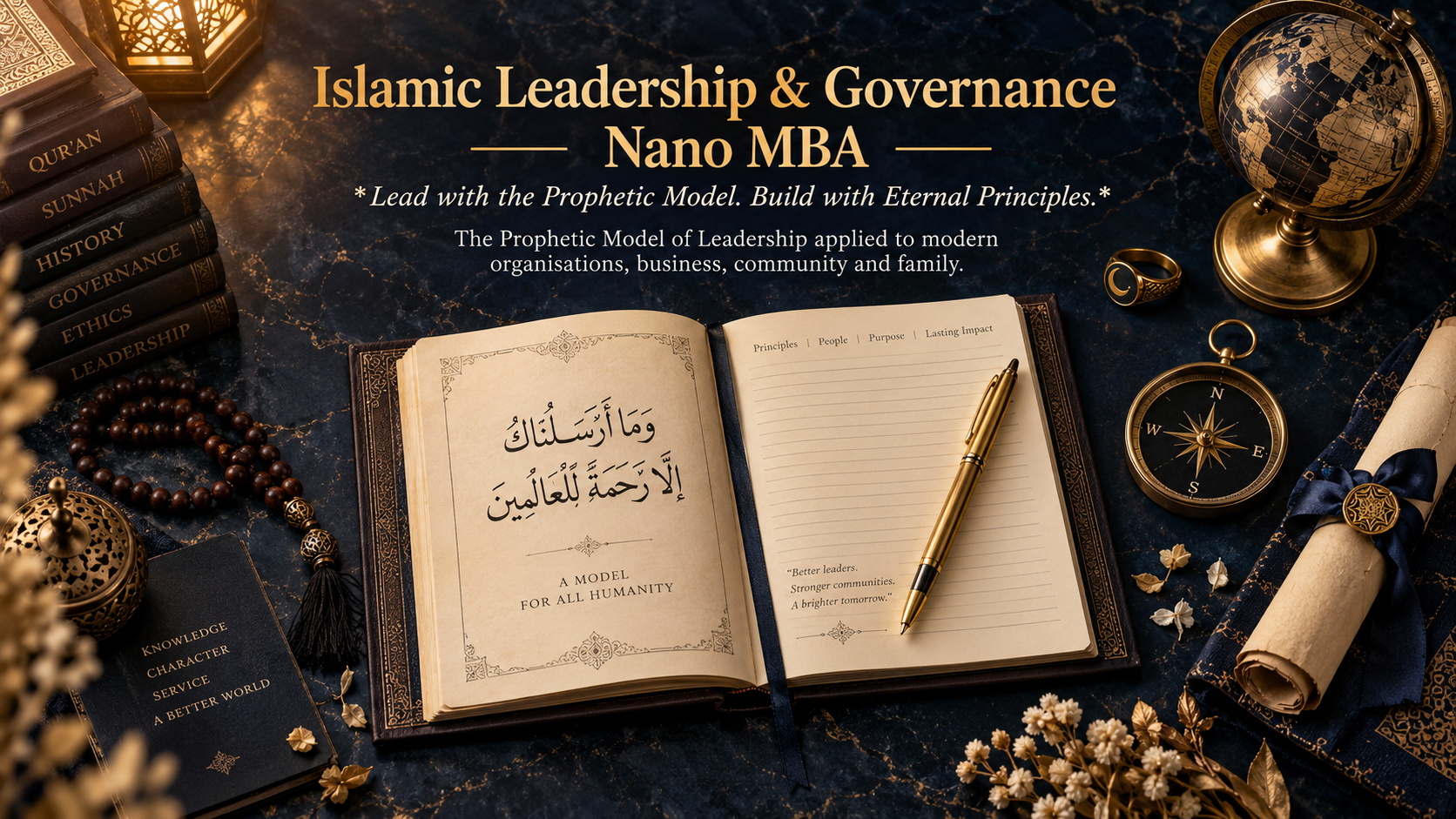
iLeadership & Governance — Nano MBA Lead with the Prophetic Model. Build with Eternal Principles.
Wishlist Share

About Course

The Prophetic Model of Leadership applied to modern organisations, business, community and family.

Bismillah ir-Rahman ir-Rahim.

كُلُّكُمْ رَاعٍ وَكُلُّكُمْ مَسْئُولٌ عَنْ رَعِيَّتِهِ

“Every one of you is a shepherd and every one of you is responsible for his flock.” — Prophet Muhammad ﷺ | Sahih Bukhari 893

You are already a leader. Whether you lead a team of thousands, a small business, a masjid committee, or a family of four — you are a shepherd. And Islam holds you accountable for your flock.

This course teaches you how to lead them well.

THE LEADERSHIP CRISIS IN THE MUSLIM WORLD

Muslim organisations suffer from leadership crises not because Islam lacks a leadership model — but because that model is not being taught, studied and applied. The Prophet ﷺ led 124,000 companions across the most diverse coalition in 7th century Arabia. Umar RA built the world’s first welfare state within two years of taking leadership. Saladin retook Jerusalem without a massacre while his enemies wrote of his nobility.

These are not just historical narratives. They are the most sophisticated leadership case studies ever documented — benchmarked by modern leadership scholars including John Adair, Karen Armstrong and Simon Sinek, who have cited Islamic leadership examples in their own works.

This course is those case studies — applied to your organisation, your business, your community, and your home.

WHAT MAKES THIS COURSE DIFFERENT

Every other leadership course draws from Western management theory — Drucker, Covey, Maxwell. These have value. But they are built on secular frameworks that leave out the most powerful leadership variable: accountability to Allah.

An Islamic leader who knows they will stand before Allah and be asked about every person in their flock — has an internal accountability mechanism more powerful than any external audit, KPI, or board of directors.

This course builds that accountability into every leadership principle — and then applies it to your modern reality.

8 MODULES — FROM PROPHECY TO PRACTICE

  • Module 1: The Prophet ﷺ as Leader — The Complete Model
  • Module 2: Khulafa al-Rashidun — Four Leadership Archetypes
  • Module 3: Amanah, Adl and Shura — The Three Pillars
  • Module 4: Leading Under Pressure — Crisis and Conflict
  • Module 5: Islamic Economic Leadership — Halal Business
  • Module 6: Family Leadership — The Islamic Home
  • Module 7: Community Leadership — Masjid and Ummah
  • Module 8: Your Leadership Legacy — Final Assessment

38 LESSONS | 18 HOURS | CERTIFICATE INCLUDED

Every lesson includes: Quranic foundation, authenticated Hadith sources, historical Islamic case study, modern application, reflection activity, and module quiz.

Sources: Sahih Bukhari, Sahih Muslim, Tafsir Ibn Kathir, Ibn Hisham’s Seerah, Al-Tabari’s History, Ibn Khaldun’s Muqaddimah — the world’s first systematic study of leadership and governance, written by a Muslim scholar in 1377 CE.

by Al Jamiatul Sultania Digital Darul Uloom — Est. 1937 — digitaldarululoom.com

Please follow and like us:
Show More

What Will You Learn?

  • (Add each as individual bullet point)
  • ✦ The Prophet ﷺ as the complete leadership model — servant leadership, transformational vision, conflict resolution and emotional intelligence from his Seerah
  • ✦ The four Rightly-Guided Caliphs as distinct leadership archetypes — and how to identify your own archetype
  • ✦ Amanah (Trust), Adl (Justice) and Shura (Consultation) as the three non-negotiable Islamic leadership foundations
  • ✦ How Abu Bakr RA managed the greatest crisis in Islamic history — applied to modern crisis leadership
  • ✦ How Umar RA built the world's first welfare state — applied to modern institutional design and governance
  • ✦ How Saladin retook Jerusalem with honour — the Islamic model of principled leadership under military pressure
  • ✦ Islamic economic leadership — Halal business ethics, prohibition of monopoly, Zakat as redistribution, and ethical profit
  • ✦ The Islamic model of family leadership — the Prophet ﷺ as husband and father, Quranic partnership in marriage
  • ✦ Masjid and community governance — Islamic charity, Waqf management, youth development and interfaith leadership
  • ✦ Ibn Khaldun's Muqaddimah — the world's first systematic study of leadership and governance, written by a Muslim scholar 647 years ago
  • ✦ The 10 Islamic Leadership Principles benchmarked against modern management theory (Drucker, Covey, Sinek)
  • ✦ Your personal Islamic Leadership Archetype — identified through structured assessment
  • ✦ A complete 90-Day Islamic Leadership Development Plan personalised to your specific role and context
  • ✦ Al Jamiatul Sultania Certificate in Islamic Leadership Studies — upon successful completion

Course Content

Islamic Leadership & Governance — Nano MBA
Lead with the character of the Prophet ﷺ. Govern with the justice of Umar RA. Build with the vision of Saladin. 38 lessons covering Islamic leadership principles, the four Caliphs as leadership archetypes, crisis management, economic leadership, community governance, and your personal Islamic Leadership Plan. Free. International standard.

  • Curriculam

Module 1 — The Prophet ﷺ as Leader: The Complete Model
The Prophet Muhammad ﷺ held more leadership roles simultaneously than any figure in recorded history: shepherd, merchant, husband, father, military general, judge, statesman, teacher and community builder. In 23 years he transformed a fragmented tribal society into a unified civilisation. This module studies his leadership model in each role — applying it directly to your modern context. Sources: Ibn Hisham's Al-Seerah Al-Nabawiyyah, Sahih Bukhari, Sahih Muslim.

Module 2 — Khulafa al-Rashidun: Four Leadership Archetypes
Four companions of the Prophet ﷺ — each with a distinct leadership style — governed the fastest-expanding civilisation in history. Abu Bakr RA: crisis leadership. Umar RA: institutional design. Uthman RA: administrative expansion. Ali RA: principled courage. This module identifies which archetype fits your natural style — and how to develop all four.

Module 3 — Amanah, Adl and Shura: The Three Pillars
Trust, Justice and Consultation are the three Quranic foundations of legitimate Islamic authority. This module provides deep Quranic analysis of each principle, traces their application through Islamic history, and builds your personal leadership framework around them. The leader who masters these three is the leader people choose to follow — even when they are not required to.

Module 4 — Leading Under Pressure: Crisis and Conflict
Every leader faces crisis. The Islamic tradition provides the most field-tested crisis leadership case studies in history: Badr (313 vs 1,000), Uhud (the consequence of disobedience), Khandaq (siege warfare and Tawakkul), the Conquest of Makkah (forgiveness as strategic genius), and the death of the Prophet ﷺ (Abu Bakr RA's defining speech). This module builds your crisis leadership capacity from these authenticated historical events.

Module 5 — Islamic Economic Leadership: Halal Business and Welfare
Umar RA built the world's first welfare state — free healthcare, pensions, scholar salaries — from Islamic economic principles. This module applies Islamic economic leadership to modern business: halal profit, prohibition of monopoly and hoarding, Zakat as redistribution, Islamic supply chain ethics, and leading organisations with both financial excellence and social responsibility.

Module 6 — Family Leadership: The Islamic Home
The Prophet ﷺ said: "The best of you is the best to his family." The family is the most important leadership unit in Islam — and the most neglected in leadership education. This module studies the Prophet ﷺ as husband and father, Quranic principles for marriage partnership, and the Islamic framework for raising the next generation of leaders.

Module 7 — Community Leadership: Masjid and Ummah
The masjid is the most powerful community institution in the Muslim world — and the most under-led. This module covers Islamic community governance, masjid management, Waqf and Islamic charity administration, youth leadership development, interfaith engagement, and representing Islam with wisdom and confidence in non-Muslim-majority contexts.

Module 8 — Your Leadership Legacy: Final Assessment
Complete your Islamic Leadership Archetype assessment. Build your personalised 90-Day Islamic Leadership Development Plan. Receive your Al Jamiatul Sultania Certificate in Islamic Leadership Studies. Write your Leadership Legacy Statement — the leader you commit to being, in the sight of Allah.

What You Have Studied

Student Ratings & Reviews

No Review Yet
No Review Yet