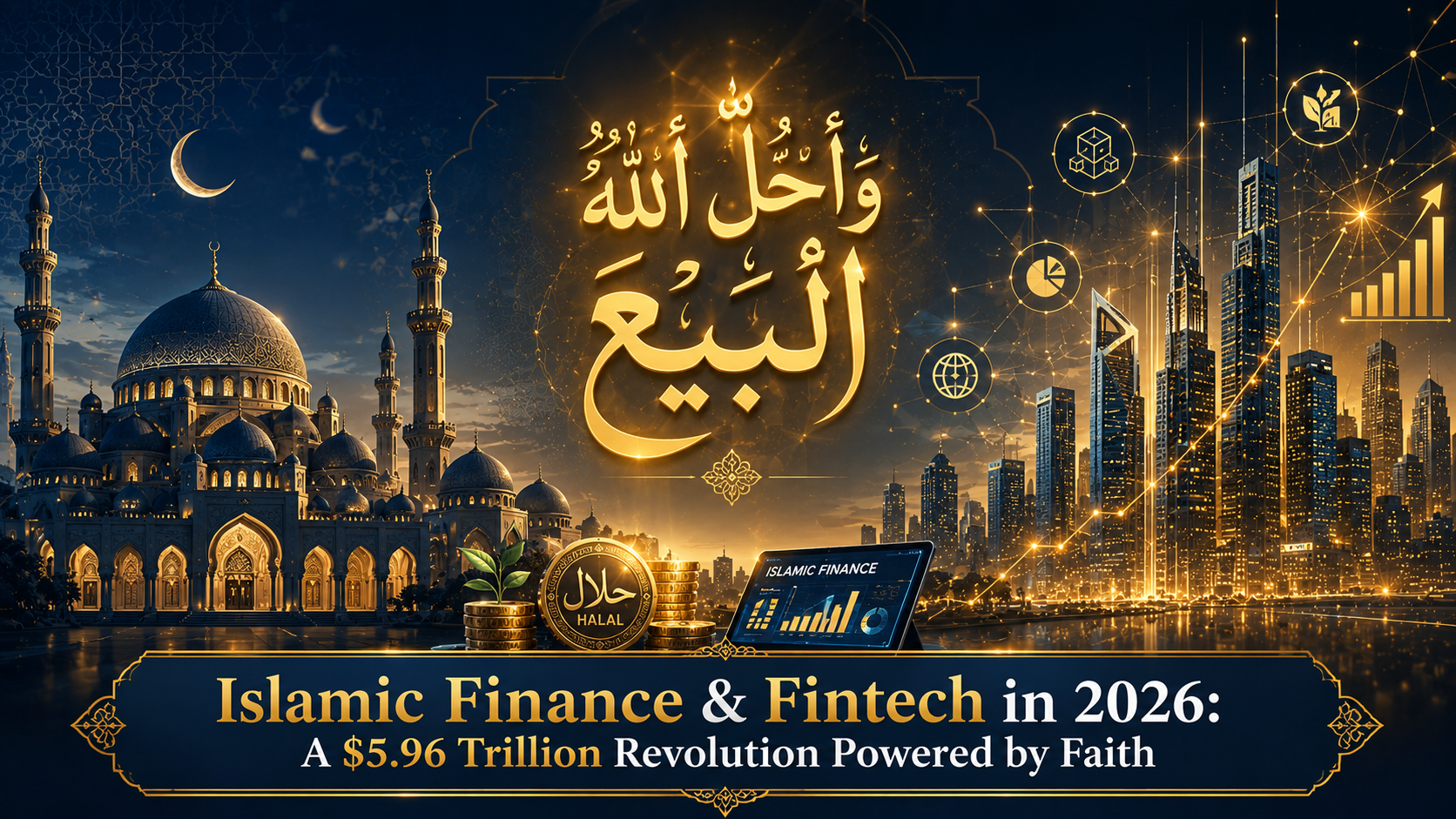
Islamic Finance & Fintech in 2026:
A $5.96 Trillion Revolution Powered by Faith
We are living in a historic moment. Islamic finance — once confined to small community-based initiatives in the 1960s — has grown into a $5.96 trillion global industry in 2026. More remarkably, it is no longer just a faith-based alternative to conventional banking. It is now being recognized worldwide as a more ethical, transparent, and sustainable model for the entire global economy. And at the heart of this revolution is technology.
📖 What Is Islamic Finance? The Foundation from Quran & Sunnah
Islamic finance is a system of financial activity governed by Shariah (Islamic law). It is built on five core principles that make it fundamentally different from conventional finance:
- No Riba (Interest): Money cannot generate money by itself. Profit must come from real trade, services, or shared risk.
- No Gharar (Excessive Uncertainty): Contracts must be clear and transparent. No hidden terms, no deceptive practices.
- No Haram Investments: No financing of alcohol, gambling, weapons, or anything prohibited in Islam.
- Risk Sharing: Both profit and loss are shared between the financier and the entrepreneur — not transferred entirely to one party.
- Asset-Backed Transactions: All financial activity must be tied to real, tangible assets or services.
In a world shaken by banking scandals, opaque financial engineering, and widening inequality, Islamic finance principles offer something rare — a financial system with built-in ethical supervision at every level. This is why it is being studied and adopted not just by Muslims, but by governments and institutions worldwide.
🚀 The Islamic Fintech Revolution — Numbers That Will Surprise You
Fintech — short for Financial Technology — has transformed how the world manages money. And the intersection of fintech with Islamic finance is creating one of the most exciting economic frontiers of our time.
Key Numbers from 2026 Global Reports:
- The global Islamic finance industry is now valued at over $3.5 trillion in assets and growing at 11% annually.
- Global Islamic finance assets are projected to reach $5.96 trillion by end of 2026 — making it one of the fastest-growing financial sectors worldwide.
- The Islamic Fintech market was estimated at $198 billion in 2025/26 and is projected to reach $306 billion by 2028 at a 17.3% annual growth rate.
- The UAE has risen to Rank 3 globally in the Islamic Fintech Index — overtaking Indonesia — becoming a world-leading hub for Islamic digital finance.
- Pakistan has emerged as a growing Islamic fintech ecosystem with companies serving over 750,000 employees and processing $5 billion+ in payments.
The global halal economy — including finance, food, fashion, travel, and education — is estimated at over $7.7 trillion. Muslim consumers are increasingly choosing products and services that reflect their values. Technology is making it easier than ever to access Shariah-compliant options in every sector of life.
🔧 5 Technologies Reshaping Islamic Finance in 2026
1. Artificial Intelligence (AI) for Shariah Compliance
One of the biggest challenges in Islamic finance has always been ensuring consistent Shariah compliance across thousands of transactions. In 2026, AI-driven compliance tools now assist Islamic scholars by analysing large transaction volumes in real time — flagging any activity that may violate Shariah principles before it is processed. This has transformed compliance from a slow, manual process into a fast, reliable system.
Wahed Invest — the world's first "halal robo-adviser" — uses algorithms to continuously verify that every investment in its portfolio remains Shariah-compliant, screening out interest-bearing instruments, haram industries, and ethically questionable companies automatically.
2. Blockchain — Transparency That Islam Demands
The Quran commands transparency and justice in all transactions. Blockchain — a technology where every transaction is permanently recorded and visible to all parties — aligns naturally with Islamic values of transparency, trust, and accountability. In 2026, blockchain is being used for:
- Sukuk (Islamic bonds) issuance and settlement — making them faster and more transparent
- Zakat collection and distribution — ensuring donations reach the right recipients with full traceability
- Halal supply chain verification — confirming that products are genuinely halal from source to consumer
- Smart contracts for Murabaha and Ijarah financing — automating Shariah-compliant transactions
3. Digital Islamic Banking
Across the globe, fully digital Islamic banks are now operating without a single physical branch. These platforms offer Shariah-compliant current accounts, savings, and financing products through smartphone apps — bringing Islamic banking to millions who previously had no access. Countries leading this transformation include UAE, Malaysia, Saudi Arabia, UK, and Indonesia.
4. Islamic Crowdfunding & Peer-to-Peer Lending
Small businesses and entrepreneurs in Muslim communities can now access Shariah-compliant funding through Islamic crowdfunding platforms. Instead of paying interest on loans, borrowers share a percentage of their profits with investors — a model called Musharakah that is directly based on Quranic principles of partnership and risk-sharing.
5. Digital Zakat & Sadaqah Platforms
Technology has made the collection and distribution of Zakat more transparent and efficient than ever before. Platforms like Zakat Coin are using blockchain to create the world's first peer-to-peer automated Zakat distribution protocol — ensuring that charitable giving reaches the right recipients with complete accountability.
🌍 Where Is the Opportunity? Countries Leading the Way
- UAE: Now ranked 3rd globally in Islamic Fintech — home to Mal ($230M funding) and Alaan ($48M funding). A world-leading ecosystem shifting from fintech hub to "institution-grade infrastructure".
- Malaysia: Controls approximately 24% of the global Islamic finance market. A strategic hub for Islamic digital economy with strong government support.
- Saudi Arabia: Number of fintech companies grew from 51 in 2021 to 200+ by 2023. Vision 2030 is driving massive Islamic fintech investment.
- UK: Home to the largest Islamic finance ecosystem outside Muslim-majority countries. Growing Muslim community driving demand for Shariah-compliant digital products.
- Pakistan: Rising fast with companies like Abhi (750,000+ users) and Haball ($5B+ in processed payments) driving financial inclusion.
- Indonesia: World's largest Muslim population driving massive demand for halal digital services across finance, food, travel, and education.
⚠️ Challenges We Must Address as Muslims
While the growth is remarkable, Islamic finance and fintech in 2026 still face significant challenges that require honest discussion:
- Lack of Standardisation: Different Shariah boards in different countries sometimes reach different conclusions on the same financial product. A unified global standard is still needed.
- Cryptocurrency Controversy: Bitcoin and most cryptocurrencies remain in a "grey area" between halal and haram. Scholars hold differing views. Muslim investors must exercise caution and consult qualified scholars.
- Talent Shortage: There is a severe shortage of professionals who understand both Islamic finance principles and modern financial technology. This is where Islamic education plays a critical role.
- Financial Literacy: Many Muslims — especially in developing countries — are not aware of Shariah-compliant financial options available to them. Education is the solution.
- Cybersecurity: Digital Islamic finance platforms face the same cybersecurity risks as conventional fintech — requiring robust protection of user data and assets.
🎓 What Can You Do? The Role of Islamic Education
The single most important factor in making Islamic finance work for the Ummah is education. Without understanding the principles, Muslims cannot:
- Identify truly Shariah-compliant financial products from those that are merely marketed as "Islamic"
- Protect themselves from Riba in everyday transactions like mortgages, credit cards, and loans
- Build careers in the rapidly growing Islamic finance and fintech sector
- Contribute to building ethical financial institutions that serve the global Ummah
At Al Jamiatul Sultania Digital Darul Uloom, we offer a dedicated Islamic Finance & Halal Business course that covers these principles in depth — combining authentic Islamic scholarship with practical modern knowledge. And it is completely free.
📚 Learn Islamic Finance — Free at Digital Darul Uloom
Enroll in our Islamic Finance & Halal Business course today. Learn from qualified scholars how to apply Shariah principles to modern financial decisions — completely free, available worldwide, anytime.
Explore Our Courses →🔚 Conclusion — Finance With a Soul
In 2026, Islamic finance is no longer asking "Is this halal?" It is asking a deeper question: "Is this structurally sound, socially responsible, and economically productive?" This shift — from identity to systems — is what makes Islamic finance relevant not just for Muslims, but for the entire world.
The $5.96 trillion Islamic finance industry is proof that ethics and prosperity are not opposites. They are partners. And as Muslims, we have a 1,400-year-old tradition of ethical commerce to draw from — one that the modern world is only beginning to discover.
The future of global finance may well be Islamic. And that future begins with education.
— Al Jamiatul Sultania Editorial Team
Digital Darul Uloom — Free Islamic & Modern Education for the World



Al Jamiatul Sultania Digital Darul Uloom is a global Islamic education platform combining authentic Islamic scholarship with modern digital education. We provide free, certified courses in Quran Studies, Arabic Language, Islamic Finance, AI and emerging technologies — empowering Muslims worldwide.

 Website