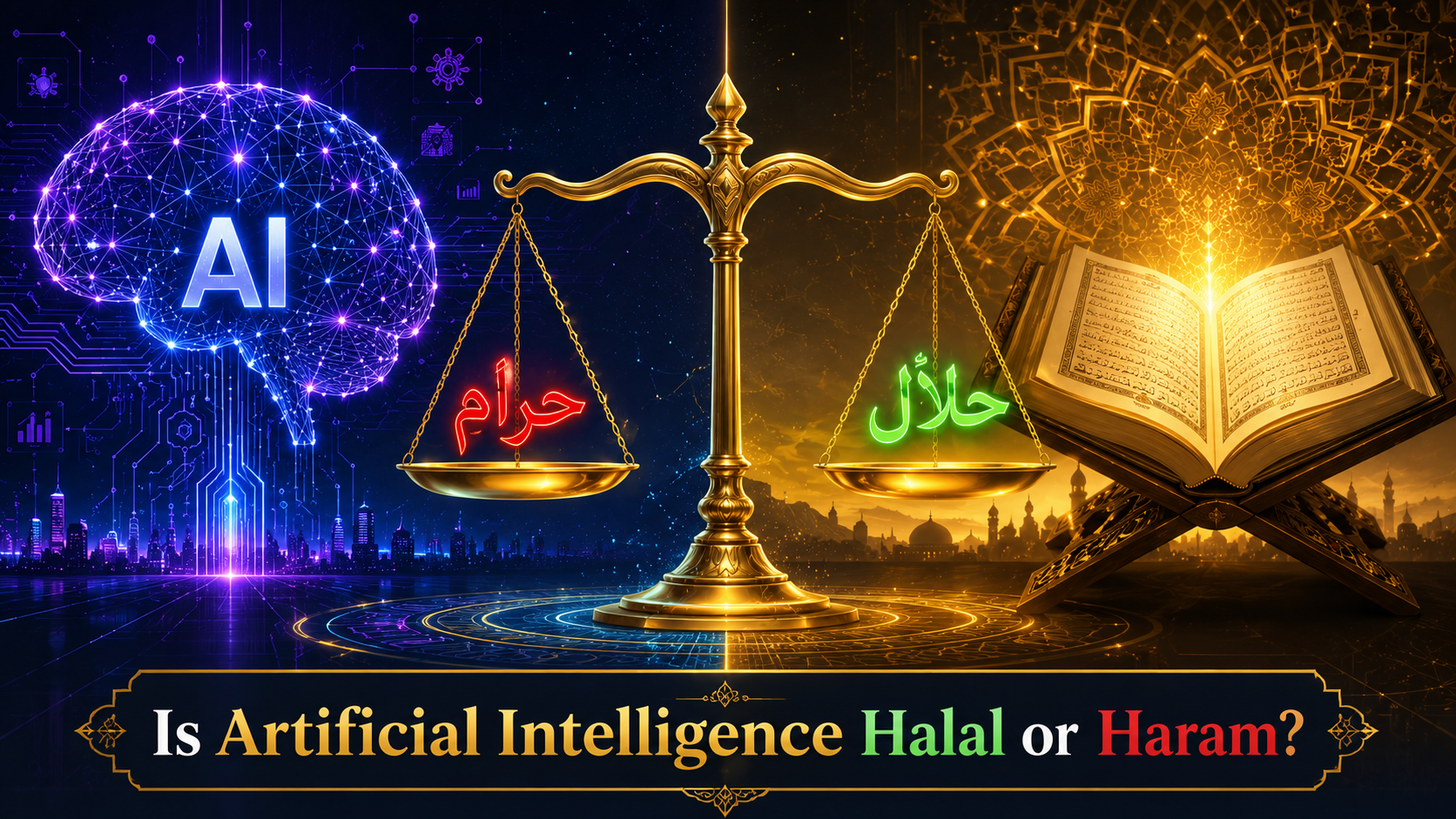
Is Artificial Intelligence Halal or Haram?
The Complete Islamic Scholar's Guide for Muslims in 2026
You are using it every day. When you ask ChatGPT a question, when Google Maps routes your journey, when Netflix recommends a show, when your bank detects fraud — that is Artificial Intelligence. AI has quietly entered every corner of our lives. And now Muslims worldwide are asking the same urgent question: Is AI halal or haram? Can I use it? Should I fear it? How should I engage with it as a Muslim? This article provides a clear, comprehensive answer — grounded in Quran, Sunnah, and the rulings of contemporary Islamic scholars.
📖 What Does Islam Say About New Technologies?
Islam does not forbid innovation or new technologies. Classical scholars, including Ibn Taymiyah, established a foundational principle of Islamic jurisprudence:
"All new things are pure and permissible unless they conflict with sacred law." — Ibn Taymiyah. This is the foundational ruling. AI itself is not inherently halal or haram. It is a tool. Like a knife — which can prepare food or cause harm — its ruling depends entirely on how it is used.
Throughout Islamic history, Muslims have engaged with every new technology of their era — the printing press, photography, radio, television, the internet — each initially causing debate before scholars reached nuanced, principled rulings. AI follows the same path.
🤖 What Exactly Is Artificial Intelligence?
Before we can judge AI from an Islamic perspective, we must understand what it actually is. Many Muslims have misconceptions about AI that lead to either unwarranted fear or reckless use.
- AI is NOT a living being. It has no Ruh (soul), no consciousness, no free will, no spiritual essence. In Islamic theology, the soul is a divine breath given only to biological sentient creatures. AI is a mathematical system — probabilistic logic processing patterns in data.
- AI is NOT all-knowing. It can only know what it has been trained on. It makes mistakes. It can be biased. It can hallucinate — generating plausible-sounding but false information.
- AI is NOT autonomous. Behind every AI system is a human being who designed it, trained it, and decides how it is used. Moral responsibility always falls on the human — not the machine.
- AI is a tool — the most powerful tool humanity has ever created. Like all tools, its permissibility depends entirely on its purpose and use.
✅ What Uses of AI Are Halal? — Scholar's Complete Guide
Contemporary Islamic scholars have broadly agreed that Artificial Intelligence is generally considered permissible (halal) in Islam because it is a tool created by humans. Its legal ruling depends entirely on execution — beneficial uses for education, research, and welfare are highly encouraged.
- Islamic education — Quran recitation tools, Tajweed correction, Arabic learning
- Medical diagnosis and healthcare — saving lives is always encouraged
- Scientific research and discovery
- Accessibility tools for disabled Muslims
- Halal food and product verification
- Business automation that serves legitimate purposes
- Climate and environmental solutions
- Zakat calculation and distribution platforms
- Translation of Islamic texts into new languages
- Fraud detection in Islamic banking
- Creating deepfakes — deceiving or defaming others
- Replicating another person's voice or face without consent
- Generating obscene, pornographic, or immoral content
- AI-powered gambling or betting systems
- Creating fake scholars, fake fatwas, or misleading religious content
- Autonomous lethal weapons systems — killing without human oversight
- Mass surveillance and privacy violations
- Using AI to cheat in education — claiming credit for work not done
- Spreading misinformation or anti-Islamic propaganda
- AI systems that deliberately target Muslims with bias
🔴 The 4 Biggest Spiritual Tests AI Poses for Muslims
While AI offers enormous benefits, it also introduces unprecedented spiritual challenges that every Muslim must understand and guard against:
1. The Test of Tawakkul — Over-Reliance on Technology
When a Muslim begins to trust AI more than Allah — consulting ChatGPT before making dua, relying on algorithms instead of seeking guidance from scholars and Allah — this represents a dangerous drift from Tawakkul (trust in Allah). AI can never replace Allah. This is not only a weakness of faith — it may even lead towards shirk if someone believes AI can control destiny.
2. The Test of Amanah — Academic and Professional Dishonesty
If AI is used to replace student effort or claim credit for work not done, it is a violation of the Islamic principle of Amanah (Trust) and is prohibited. A Muslim student who submits AI-generated work as their own is engaging in deception — directly contradicting the Islamic values of honesty (Sidq) and trustworthiness (Amanah).
3. The Test of Haya — Exposure to Haram Content
AI-powered recommendation algorithms on social media are designed to maximise engagement — often by showing increasingly extreme, immoral, or haram content. A Muslim who passively consumes whatever AI algorithms serve them — without conscious filtering — is allowing technology to erode their haya (modesty) and iman (faith).
4. The Test of Fitna — Misinformation and False Knowledge
AI can generate highly convincing fake fatwas, fake Hadith, fake scholarly opinions, and fake religious rulings. Creating fake imams, fake scholars, or exploiting people's religious emotions through AI is haram. Muslims must verify all religious information against authentic scholars — never accepting AI-generated religious content without verification.
⚖️ The Scholar's Framework — Triple-A Standard for AI
Islamic scholars have developed a comprehensive framework for evaluating AI use. To navigate this era safely, scholars deploy the Triple-A Standard: Agency (Aql), Accountability (Amanah), and Authenticity (Sidq).
🏗️ The Responsibility of Muslim AI Developers
Muslims who work in technology — software engineers, data scientists, AI researchers — carry a special amanah. Muslim developers of AI must ensure halal filters, prevention of obscenity, avoidance of misinformation, no anti-Islamic output, and no deception or harm. This is not just a responsibility — it is an amanah.
- Build AI systems with halal content filters — blocking obscene, violent, or misleading content
- Protect user privacy — in line with Islamic principles of Sitr (privacy)
- Ensure AI systems do not discriminate against or harm Muslim communities
- Never build autonomous weapons systems that kill without human oversight
- Build AI tools that serve the Ummah — Islamic education, healthcare, economic empowerment
🎓 Practical Guide — How Muslims Should Use AI Daily
✅ Do This:
- Use AI for Islamic learning — Quran apps, Arabic learning, Hadith search, Islamic knowledge exploration
- Use AI to check your work — not to bypass learning. Understand the output rather than just copying it
- Verify religious information — always cross-check AI-generated religious content with qualified human scholars
- Review privacy policies of AI tools you use — protect your personal data
- Use AI for productivity — legitimate business purposes, research, writing assistance
- Stay conscious of time — AI-powered social media is designed to consume your time. Guard your salah times
❌ Avoid This:
- Never accept AI-generated fatwa or religious ruling without scholar verification
- Never use AI to create deceptive content — fake images, fake voices, misleading information
- Never submit AI-generated work as your own in education or professional settings
- Never allow AI algorithms to determine what Islamic content you consume — seek authentic sources
- Never treat AI as infallible — it makes mistakes, has biases, and can generate false information
🌟 AI as a Tool for Islamic Da'wah — Our Opportunity
The Islamic Golden Age was built on Muslims being at the frontier of every field of knowledge — mathematics, medicine, astronomy, philosophy, and more. In 2026, AI is the frontier. And Muslims have an extraordinary opportunity:
Imagine AI tools that teach Quran to millions of children who have no access to a teacher. AI that detects misinformation about Islam and corrects it in real time. AI translation tools that make Islamic scholarship accessible in 100 languages. AI-powered Zakat systems that ensure every eligible Muslim receives what they are entitled to. This is not a dream — it is within reach. But only if Muslims engage with AI rather than fear or ignore it.
Preparing for the challenges of our time — in 2026 — means understanding, mastering, and ethically applying Artificial Intelligence for the benefit of the Ummah and humanity.
🎓 Study AI & Digital Technology at Digital Darul Uloom — Free
Our AI & Digital Technology course combines authentic Islamic ethics with practical modern technology skills. Learn how AI works, how to use it ethically as a Muslim, and how to build a career in the halal digital economy — completely free, taught by qualified scholars and technology professionals.
Enroll Free Today →🔚 Conclusion — Be the Master of AI, Not Its Slave
Artificial Intelligence is neither a miracle nor a monster. It is a tool — the most powerful our generation has ever encountered. Like all tools in Islamic history, its ruling is determined by intention (niyyah), use, and impact on human dignity and societal justice.
If an AI tool meets the tests of good intention, fairness, transparency, accountability, privacy, and non-harm, its use can be considered halal. But that does not mean every AI use qualifies.
As Muslims, we are called to be stewards of this earth — Khulafah. That means engaging with every era's most powerful tools and ensuring they serve justice, knowledge, and human dignity. In 2026, that tool is AI. Will we master it for the benefit of the Ummah — or allow others to shape it without our values?
The choice — as always in Islam — begins with Niyyah. What is your intention?
— Al Jamiatul Sultania Editorial Team
Digital Darul Uloom — Free Islamic & Modern Education for the World


Al Jamiatul Sultania Digital Darul Uloom is a global Islamic education platform combining authentic Islamic scholarship with modern digital education. We provide free, certified courses in Quran Studies, Arabic Language, Islamic Finance, AI and emerging technologies — empowering Muslims worldwide.
 Website