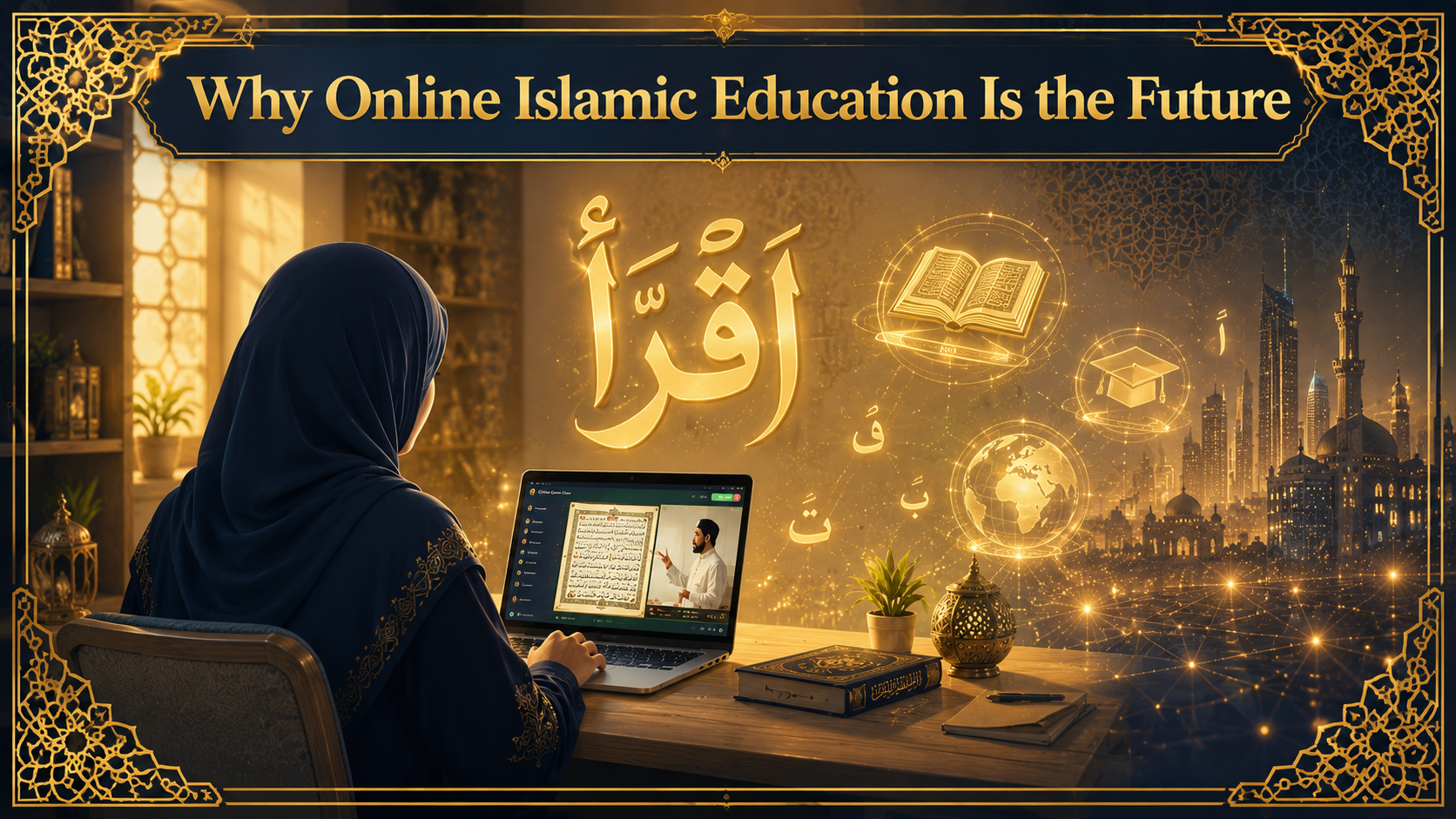
Why Online Islamic Education Is the Future —
And How to Choose the Right Platform in 2026
The Prophet Muhammad ﷺ said: "Seeking knowledge is an obligation upon every Muslim." (Ibn Majah). For 1,400 years, Muslims fulfilled this obligation through mosques, madrasas, and scholars. But in 2026, a transformation is happening that would have been unimaginable even 20 years ago — a student in rural Nigeria can now learn Quranic Arabic from a scholar in Egypt. A Muslim in the United States can study Fiqh from an Alim in India. A revert in England can learn the fundamentals of Islam from qualified teachers in Saudi Arabia. All from a smartphone. All for free. This is the future of Islamic education — and it is already here.
📖 Islam's Command — Knowledge Is Fardh (Obligatory)
The very first word revealed to our beloved Prophet Muhammad ﷺ was Iqra — Read! Not pray. Not fast. Not give Zakat. The first divine command was to seek knowledge. This tells us something profound about Islam's relationship with education — it is not optional. It is the foundation.
Allah (SWT) does not just permit the pursuit of knowledge — He elevates those who seek it. In 2026, online platforms are making this divine elevation accessible to every Muslim on earth, regardless of geography, income, or circumstance.
🌍 The Challenge — 1.9 Billion Muslims, Not Enough Scholars
There are approximately 1.9 billion Muslims worldwide. But qualified Islamic scholars — Ulama with proper Ijazah and deep knowledge of Quran, Hadith, Fiqh, and Arabic — number in the thousands. The gap between knowledge-seekers and knowledge-givers has always been one of the greatest challenges facing the Ummah.
- Geographically limited — need to be near a madrasa or mosque
- Expensive — tuition, accommodation, travel costs
- Limited schedules — fixed class times that conflict with work/family
- Language barriers — most top scholars teach in Arabic or Urdu
- Gender barriers — limited options for Muslim women seeking higher Islamic education
- Remote communities — no qualified teachers available locally
- Globally accessible — learn from any country, any city, any village
- Free or affordable — removing financial barriers completely
- Flexible schedules — study at your own pace, any time of day or night
- Multilingual content — courses in English, Arabic, Urdu, and more
- Women-inclusive — safe, structured, dedicated learning for Muslim women
- Mobile-first — 73% of Muslims access learning through smartphones
🔧 5 Technologies Transforming How Muslims Learn Islam in 2026
1. AI-Powered Tajweed Correction
Artificial Intelligence can now listen to a student's Quran recitation and instantly identify mistakes in Tajweed — the rules of correct pronunciation. What once required a qualified teacher sitting next to a student can now happen through a smartphone app, providing real-time feedback on Makharij (articulation points), Sifat (characteristics of letters), and common recitation errors.
While AI tools are helpful for practice, qualified Islamic scholars emphasize that human supervision remains essential for proper Quranic education. AI can assist — but it cannot replace the spiritual guidance, personal connection, and wisdom that a human teacher provides. At Digital Darul Uloom, we combine technology with qualified human scholars.
2. Video Learning from World-Class Scholars
Students in the UK, USA, Canada, and Australia can now access lectures from renowned scholars in Egypt, Saudi Arabia, Pakistan, and India through high-quality video platforms. Live-streamed lectures, recorded courses, and Q&A sessions with scholars are bringing the traditional student-teacher relationship into the digital age.
3. Interactive Quran Study Tools
Digital Mushafs (Quran copies) with built-in word-by-word translation, Tafsir explanations, audio recitations from master Qaris, and memorization tracking tools are making Quran study more engaging and effective than ever before. Students can tap on any word and instantly see its Arabic root, grammatical function, and meaning.
4. Global Online Study Groups
Platforms like Zoom and dedicated Islamic learning apps enable students from different countries to form study circles — the modern equivalent of the traditional Halaqah. A student in Malaysia, another in Nigeria, and a third in the United States can study together under the guidance of a single qualified scholar — something that was physically impossible before digital technology.
5. Blockchain Certification
A new and important development in 2026 is the use of blockchain technology to issue tamper-proof Islamic education certificates. These digital credentials cannot be faked or altered — ensuring that a student's Islamic education qualifications are genuine and verifiable anywhere in the world. This is particularly important as demand for qualified Islamic teachers, advisors, and scholars grows globally.
⚠️ How to Choose the Right Online Islamic Education Platform
Not all online Islamic education platforms are equal. With the growth of the industry, some platforms prioritise profit over authentic scholarship. Here is what to look for:
✅ What a Good Platform Must Have:
- Qualified Scholars with Ijazah — Teachers must have proper Islamic credentials and chain of knowledge going back to the Prophet ﷺ
- Authentic Curriculum — Based on Quran, Sunnah, and established Islamic scholarship — not personal opinions
- Structured Learning Path — Clear progression from beginner to advanced, with proper assessment
- Transparency — Clear information about who the scholars are, their qualifications, and their methodology
- Free or Affordable — The Prophet ﷺ said knowledge should be freely shared. Platforms that charge excessive fees for basic Islamic knowledge should be questioned
- Multilingual Support — For international Muslim communities who do not speak Arabic as a first language
- Both Islamic AND Modern Knowledge — Muslims need both Deen and Dunya — faith and practical skills for the modern world
⚠️ Warning Signs to Avoid:
- Unnamed or unqualified "scholars" with no verifiable credentials
- Platforms that mix controversial or extreme interpretations with mainstream Islamic scholarship
- Excessive fees for basic knowledge that should be freely accessible
- No interaction with real human teachers — purely automated AI learning
- Lack of transparency about curriculum sources and methodology
🕌 The Golden Age of Islam — When Education Was Our Superpower
Between the 8th and 13th centuries, the Islamic world led global civilization in science, mathematics, medicine, astronomy, philosophy, and literature. Baghdad's House of Wisdom (Bayt al-Hikmah) was the world's greatest center of learning. Muslim scholars translated, preserved, and advanced the knowledge of the ancient world — and added enormously to it.
We can read Aristotle's works today because Arabic translators preserved and translated them during the Islamic Golden Age. Muslim scholars like Ibn Sina (Avicenna), Al-Khwarizmi (father of Algebra), Al-Biruni, and Ibn Rushd (Averroes) formed the intellectual foundation of the modern world. The secret of their greatness? They saw no contradiction between Islamic faith and worldly knowledge. Both were gifts from Allah to be pursued.
In 2026, online Islamic education is our generation's opportunity to reclaim that tradition — combining authentic Islamic scholarship with modern knowledge, making it accessible to every Muslim on earth.
🎯 Why Digital Darul Uloom Is Different
Al Jamiatul Sultania Digital Darul Uloom was built on one belief: authentic Islamic education combined with modern knowledge should be free for every Muslim on earth.
- Qualified Islamic scholars with verified credentials teaching all Islamic courses
- Modern technology courses — AI, Blockchain, Digital Business, Islamic Finance — taught alongside Islamic studies
- Completely free — no subscription, no hidden fees, no premium paywalls
- Available worldwide — students from India, UAE, USA, UK, Nigeria, Malaysia, Pakistan and beyond
- Multilingual — content in English, Arabic, and Urdu
- Structured curriculum — from beginner to advanced, with certificates on completion
- Mobile-friendly — learn on any device, anytime, anywhere
🎓 Start Your Islamic Education Journey — Free Today
Join thousands of students from across the world who are learning authentic Islam combined with modern knowledge at Al Jamiatul Sultania Digital Darul Uloom. Quran, Hadith, Arabic, Islamic Finance, AI, Technology — all free, all online, all accessible from your phone.
Explore All Courses →🔚 Conclusion — Your Knowledge Is Your Ibadah
The Prophet Muhammad ﷺ said: "When a person dies, their deeds come to an end except for three things: Sadaqah Jariyah (ongoing charity), beneficial knowledge, and a righteous child who prays for them." (Muslim)
Knowledge that benefits others continues to reward us after death. When you learn Islamic knowledge and share it, when you teach your children, when you help build platforms that spread authentic education — you are creating a legacy that lasts beyond this world.
Online Islamic education in 2026 is not just about convenience. It is about fulfilling Allah's first command — Iqra — Read! — in the most powerful way available to our generation.
The scholars of the past would have given anything for the tools we have today. Let us not waste them.
— Al Jamiatul Sultania Editorial Team
Digital Darul Uloom — Free Islamic & Modern Education for the World


Al Jamiatul Sultania Digital Darul Uloom is a global Islamic education platform combining authentic Islamic scholarship with modern digital education. We provide free, certified courses in Quran Studies, Arabic Language, Islamic Finance, AI and emerging technologies — empowering Muslims worldwide.
 Website