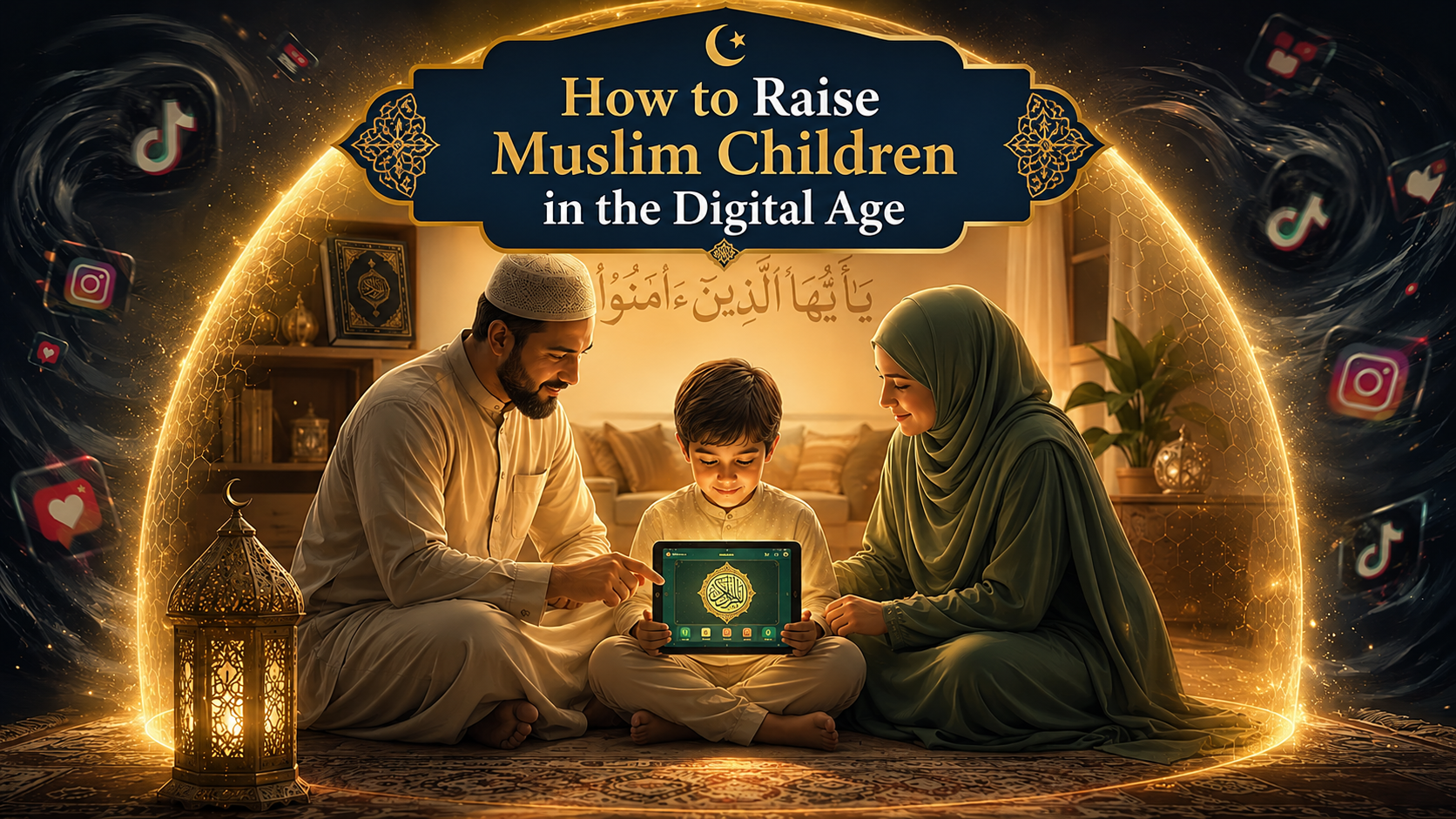
How to Raise Muslim Children in the Digital Age —
A Complete Islamic Parenting Guide for 2026
Every Muslim parent shares the same dua — Ya Allah, make my children among the righteous. But in 2026, raising righteous Muslim children requires navigating a challenge that no generation of Muslim parents before us has ever faced: raising children in a world where an algorithm knows your child better than you do. Where TikTok, YouTube, and social media are competing for your child's heart, mind, and Iman — 24 hours a day, 7 days a week. This is not a crisis of technology. It is a crisis of Tarbiyah. And Islam — as always — has the answer.
📖 The Islamic Foundation — Children Are Amanah, Not Property
This verse is the foundation of Islamic parenting. Allah does not say "educate" your families or "feed" your families — He says protect them. In 2026, protecting our families means protecting them from the Fire — and also protecting their Iman, their Fitra, their character, and their mental health from the dangers of unguided digital life.
"Every child is born upon Fitra (pure natural state). Then his parents make him a Jew, a Christian, or a Magian." (Bukhari & Muslim). In 2026, we add: or his algorithm makes him an influencer-worshipper, a materialist, or someone lost between identities. The responsibility — and the opportunity — remains with the parents.
In Islam, children are an Amanah — a sacred trust from Allah. Children are raised to flourish as successive human authority on earth. In Islam, they are an Amanah, a sacred trust. Therefore, active, assertive parenting is a moral obligation. It calls for love, emotional bonding, and gentleness balanced with limits and discipline without neglect.
🎯 The Prophet's ﷺ Three-Stage Parenting Framework
Islamic scholars have long taught a beautiful three-stage framework derived from Prophetic wisdom — and it maps perfectly onto the digital challenges of 2026:
⚠️ The 5 Biggest Digital Dangers for Muslim Children in 2026
1. Algorithm-Driven Identity Loss
Technology itself is not the problem. The challenge lies in how it draws attention, normalises values that clash with Islamic ethics, and places teenagers in spaces that reward exposure rather than character development. When a Muslim child spends 7 hours daily consuming content chosen by an algorithm — they are allowing that algorithm to shape their values, their aspirations, and their identity. The question every Muslim parent must ask: who is raising my child — me or the algorithm?
2. Social Media Addiction & Mental Health
Research shows negative associations between screen time and the development of physical and cognitive abilities, with links to obesity, sleep problems, depression, and anxiety. Muslim children are not immune. The dopamine reward system that social media exploits is the same in every child — Muslim or not. Likes, followers, and viral content can become more powerful motivators than pleasing Allah.
3. Exposure to Haram Content
A single search, a single click, a single recommendation — and a Muslim child can be exposed to content that directly contradicts everything we are teaching them. Exposure to content that is not in accordance with Islamic values, such as violent content, pornography, and hedonistic culture, is a serious threat to children's moral development.
4. Cyberbullying & Online Harassment
Muslim children — especially girls who wear hijab — face targeted cyberbullying and Islamophobic harassment online. This causes significant psychological harm and can lead to crisis of faith and identity. Parents must create safe, open communication so children feel comfortable reporting online harassment immediately.
5. Fake Islamic Knowledge
AI-generated fake fatwas, misquoted Hadith, out-of-context Quranic verses, and sectarian propaganda spread rapidly on social media. A Muslim child without strong foundational Islamic education is vulnerable to adopting extreme, false, or misleading Islamic views from unqualified online "scholars."
🛡️ The Islamic Digital Parenting Framework — 7 Practical Strategies
Strategy 1 — Be the Digital Shepherd, Not the Digital Stranger
The Prophet Muhammad ﷺ said: "Each of you is a shepherd and is responsible for his flock." In 2026, this means parents must actively shepherd their children's online experiences rather than allowing algorithms to guide them.
Know what your children are watching, who they are talking to, and what apps they are using. This is not spying — it is shepherding. Do it with wisdom, love, and open conversation — not with suspicion and punishment.
Strategy 2 — Use Salah Times as Natural Digital Breaks
Research with Muslim communities found that integrating technology breaks around prayer times may be particularly feasible, as prayer occurs five times daily and is considered a pillar of Islam. Families can implement: Digital sunset beginning with Maghrib prayer, creating technology-free family time; Morning focus sessions after Fajr prayer before checking devices; Weekly digital sabbath from Friday afternoon to Saturday morning for family bonding and Islamic study.
Strategy 3 — Build Fitra Before They Build a Following
The strongest protection against digital harms is a child who knows who they are — a Muslim, a servant of Allah, with a clear purpose and identity. Invest deeply in Islamic education before your child gets a smartphone. A child with strong Iman and Islamic identity is far more resistant to online pressures than one who is still searching for who they are.
Strategy 4 — Teach Islamic Ethics for the Online World
- No backbiting in comments — same as real life
- No spreading unverified news — check before sharing
- Treat others online as you would face to face
- Protect your own and others' privacy (Sitr)
- No photos or videos that violate modesty (Haya)
- No phones during family meals — ever
- No devices in bedrooms after Isha
- No social media before age 14 minimum
- Family device agreement signed by all
- Weekly family tech-free activity together
Strategy 5 — Model the Behavior You Want to See
Children are more likely to emulate what they see rather than what they are told, making parental modeling crucial for healthy digital habits. Muslim parents should demonstrate balanced technology use, regular digital breaks for prayer, and prioritizing face-to-face family time. If you are on your phone during salah time, your children will follow. If you put your phone away for family dinner, they will follow that too.
Strategy 6 — Replace, Don't Just Restrict
Simply taking away a phone without offering meaningful alternatives breeds resentment. Replace screen time with:
- Islamic education — enroll your children in free online Islamic courses like Digital Darul Uloom
- Physical activity — sports, outdoor play, family walks after Maghrib
- Creative hobbies — art, writing, Quran memorization, Arabic calligraphy
- Community involvement — mosque activities, Islamic youth groups, volunteering
- Quality family time — game nights, Islamic storytelling, cooking together
Strategy 7 — Keep the Conversation Open Always
Create an environment where children feel comfortable discussing online experiences, concerns, and mistakes without fear of punishment. This openness enables early intervention when problems arise. A child who knows they can come to you with any problem — without being punished or shamed — is a child who will come to you before a problem becomes a crisis.
🌟 The Opportunity — Digital Tools That Strengthen Iman
The digital age is not only a threat — it is also an extraordinary opportunity. Used wisely, technology can strengthen your children's Islamic identity:
- Free online Quran and Islamic courses — like Digital Darul Uloom — giving children access to qualified scholars worldwide
- Islamic apps — Quran memorization, prayer time reminders, daily Hadith, Islamic audiobooks
- Global Muslim community — connecting your children with Muslim peers worldwide who share their values
- Islamic content creators — authentic scholars and educators producing high-quality Islamic content on YouTube and social media
- Arabic learning platforms — giving children direct access to the language of the Quran
🎓 Give Your Children the Gift of Free Islamic Education
Enroll your children at Al Jamiatul Sultania Digital Darul Uloom — free, structured Islamic and modern education for students worldwide. Quran studies, Arabic language, Islamic ethics, and modern technology courses — taught by qualified scholars, completely free, accessible from any device.
Enroll Your Child Free Today →🔚 Conclusion — You Are Raising the Future of the Ummah
The goal of Islamic parenting remains unchanged: to raise individuals who are slaves to Allah alone, free from the shackles of societal trends and digital addictions. By rooting our homes in the Quran and the Sunnah, we provide our children with a compass that never fails, no matter how much the landscape changes. We are not just raising children; we are raising the future of the Ummah.
The digital age has changed the tools of Tarbiyah — but not its purpose. Our purpose, as Muslim parents, has always been the same: to return our children to Allah in the best possible state. In 2026, that means being the Digital Shepherd our children need — present, wise, loving, and anchored in the timeless guidance of Quran and Sunnah. May Allah make our children the coolness of our eyes, in this world and the next. Ameen.
— Al Jamiatul Sultania Editorial Team
Digital Darul Uloom — Free Islamic & Modern Education for the World


Al Jamiatul Sultania Digital Darul Uloom is a global Islamic education platform combining authentic Islamic scholarship with modern digital education. We provide free, certified courses in Quran Studies, Arabic Language, Islamic Finance, AI and emerging technologies — empowering Muslims worldwide.

 Website