بِسْمِ اللهِ الرَّحْمَٰنِ الرَّحِيمِ
“And We send down of the Quran that which is a healing and a mercy for the believers.” — Quran 17:82
For 1,400 years, Muslims followed the dietary guidance of Prophet Muhammad ﷺ — not because they had laboratory results, but because they trusted divine wisdom. Today, modern science is spending billions of dollars to confirm what the Prophet ﷺ told us in a single sentence.
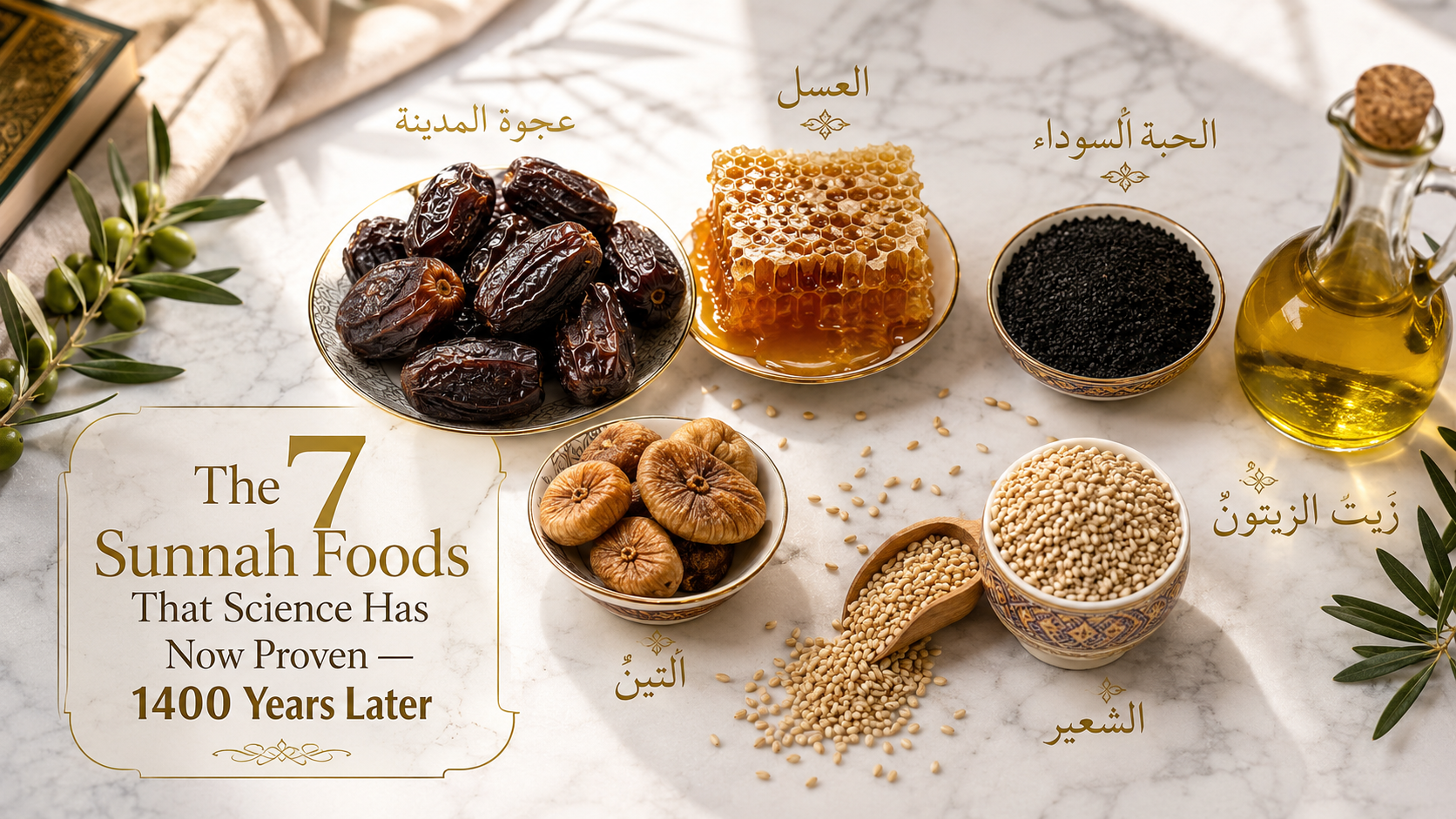
Here are 7 Sunnah foods that science has now validated — and how to incorporate them into your daily life.
1. Black Seed (Habbatus Sauda) — The Miracle Seed
“Use this black seed — for in it is a cure for every disease except death.” — Bukhari
For decades, Western medicine dismissed this Hadith as religious folklore. Then came the research.
What science says: Over 900 peer-reviewed studies have been published on Nigella Sativa (black seed). Researchers have identified Thymoquinone — a compound found exclusively in black seed — as one of the most powerful natural anti-cancer, anti-inflammatory, and immune-boosting substances ever discovered.
Studies published in journals including Cancer Research, Journal of Ethnopharmacology, and Phytotherapy Research have found black seed:
- Reduces tumour size in multiple cancer types
- Lowers blood pressure significantly
- Controls blood sugar in Type 2 diabetes
- Fights antibiotic-resistant bacteria
- Reduces asthma symptoms
- Combats H. pylori (stomach ulcer bacteria)
How to use today:
- 1 teaspoon black seed oil on empty stomach every morning
- Mix with honey for respiratory conditions
- Add seeds to cooking for general wellness
2. Dates (Tamr) — The Complete Food
“A household that has dates will not go hungry.” — Muslim
The Prophet ﷺ broke his fast with dates. He recommended seven Ajwa dates every morning. He said dates are blessed.
What science says: Dates contain:
- Natural sugars (glucose + fructose) — immediate and sustained energy
- Potassium — more than bananas
- Magnesium — essential for 300+ enzymatic reactions
- Iron — prevents anaemia (especially important for women)
- Tannins — powerful antioxidants
Most remarkably — a 2011 study published in the Journal of Obstetrics and Gynaecology found that women who consumed dates in the last 4 weeks of pregnancy had:
- Significantly greater cervical dilation
- Higher rates of intact membranes at admission
- Significantly shorter latent phase of labour
The Prophet ﷺ specifically encouraged dates for pregnant women and new mothers 1,400 years before this research.
How to use today:
- 7 Ajwa dates every morning (as Sunnah)
- Date syrup as natural sweetener instead of refined sugar
- Dates + milk = complete nutritional drink
3. Honey (Asal) — The Ancient Antibiotic
“Healing is in three things: a drink of honey, a cut with the knife used in cupping, and branding with fire.” — Bukhari
“There comes forth from their bellies a drink of varying colours wherein is healing for people.” — Quran 16:69
Honey was used as medicine for thousands of years across civilisations. Then antibiotics arrived — and honey was forgotten. Now antibiotic resistance has brought honey back — with compelling scientific reason.
What science says: Honey contains hydrogen peroxide, methylglyoxal (MGO), and bee defensin-1 — a combination that creates a triple-action antibacterial effect.
Studies from the Journal of Wound Care have found that Manuka honey:
- Heals infected wounds that resisted antibiotics
- Kills MRSA (Methicillin-resistant Staphylococcus aureus)
- Significantly reduces recovery time for sore throats (better than antibiotics in some studies)
The Quran specifically mentions honey comes from the bee’s belly “in varying colours” — and indeed, the medicinal properties of honey vary by colour and source, something science only recently confirmed.
How to use today:
- Raw honey (not heated — heat destroys enzymes)
- 1-2 tablespoons morning and evening
- Applied topically to minor wounds
- Mixed with black seed for immune boost
4. Olive Oil (Zayt) — Heart Medicine
“Eat olive oil and use it as an ointment, for it comes from a blessed tree.” — Tirmidhi
What science says: The Mediterranean diet — centred on olive oil — is the most scientifically validated diet for longevity and disease prevention in history.
Extra Virgin Olive Oil contains:
- Oleocanthal — a compound with the same anti-inflammatory mechanism as ibuprofen
- Oleic acid — reduces LDL (bad cholesterol) while maintaining HDL (good cholesterol)
- Polyphenols — powerful antioxidants preventing cell damage
The PREDIMED study — one of the largest nutrition studies ever conducted — found that people following a Mediterranean diet rich in olive oil had:
- 30% reduction in major cardiovascular events
- 40% reduced risk of stroke
- Significantly lower rates of breast cancer
- Reduced cognitive decline
How to use today:
- 2-3 tablespoons Extra Virgin Olive Oil daily
- Use for cooking (it is stable at moderate heat)
- Drizzle on salads, bread, vegetables
- Apply to skin as natural moisturiser
5. Talbina (Barley Porridge) — The Prophetic Antidepressant
“Talbina gives rest to the heart of the sick person and relieves some of his sorrow.” — Bukhari
This single Hadith describes Talbina as a remedy for grief and sorrow. For centuries it was understood as spiritual comfort. Then nutritional science provided a biological explanation.
What science says: Barley contains:
- Tryptophan — the amino acid precursor to serotonin (the happiness neurotransmitter)
- Beta-glucan — a fibre that feeds beneficial gut bacteria, which produce 90% of the body’s serotonin
- Magnesium — deficiency is strongly linked to depression and anxiety
The gut-brain connection — now one of the hottest areas of psychiatric research — explains perfectly why the Prophet ﷺ recommended a gut-healing food for grief. The gut literally produces the chemicals that regulate mood.
How to make Talbina: 2 tablespoons barley flour + 1 cup warm milk + 1 tablespoon raw honey + cinnamon. Cook 10 minutes on low heat. Serve warm.
When to use: Illness, grief, depression, anxiety, postnatal period, during Ramadan.
6. Fasting (Sawm) — Cellular Repair
“Fast and you will be healthy.” — (Various narrations, widely cited)
“Fasting is a shield.” — Bukhari
What science says: In 2016, Japanese cell biologist Yoshinori Ohsumi won the Nobel Prize in Physiology or Medicine for his research on autophagy — the process by which cells clean and repair themselves.
Autophagy is triggered by fasting.
During fasting, the body:
- Removes damaged cellular components
- Recycles cellular waste
- Activates anti-cancer pathways
- Improves insulin sensitivity
- Reduces inflammation markers
- Triggers stem cell production
The Prophet ﷺ fasted every Monday and Thursday — what we now call intermittent fasting — the most researched dietary intervention in modern nutritional science.
Ramadan fasting (one month annually) has been studied extensively. Research consistently shows improvements in: blood sugar, blood pressure, cholesterol, weight, and inflammatory markers.
How to practice:
- Monday and Thursday fasting (Sunnah fasting = intermittent fasting)
- Begin with one of these days if new to fasting
- Break fast with dates and water (exactly as Sunnah instructs — dates spike glucose gradually, water hydrates)
7. Zamzam Water — The Uniquely Mineralised Water
“The best water on the face of the earth is Zamzam water. In it is food for hunger and cure for illness.” — Tabarani
What science says: Chemical analysis of Zamzam water reveals a unique mineral composition:
- Calcium levels significantly higher than normal water
- Magnesium levels above average
- Fluoride at optimal levels for dental health
- pH of 7.9-8.0 — slightly alkaline (optimal for biological processes)
- Zero contamination — despite being open well water for millennia
German scientist Dr. Knut Pfeiffer of the European Institute of Hydro-Geologists tested Zamzam water and stated: “The quality of Zamzam water is unlike any other water in the world.”
Scientists have no natural geological explanation for why this water maintains its exceptional quality in a desert environment.
The Conclusion Science Reached — 1400 Years Later
The Prophet Muhammad ﷺ delivered these dietary recommendations over 14 centuries ago in the Arabian desert — without laboratories, without research funding, without peer review.
Modern science, with all its sophisticated tools, continues to confirm the wisdom in those recommendations — one study at a time.
“And He taught Adam the names of all things.” — Quran 2:31
Allah gave His Prophet ﷺ knowledge. We are only now catching up.
Sources:
- Bukhari, Hadith collections (sunnah.com)
- Journal of Ethnopharmacology, Multiple issues
- PREDIMED Study, New England Journal of Medicine, 2013
- Journal of Obstetrics and Gynaecology, 2011
- WHO Nutrition Division reports
- Ohsumi, Y. (2016). Nobel Lecture on Autophagy.


Al Jamiatul Sultania Digital Darul Uloom is a global Islamic education platform combining authentic Islamic scholarship with modern digital education. We provide free, certified courses in Quran Studies, Arabic Language, Islamic Finance, AI and emerging technologies — empowering Muslims worldwide.
 Website