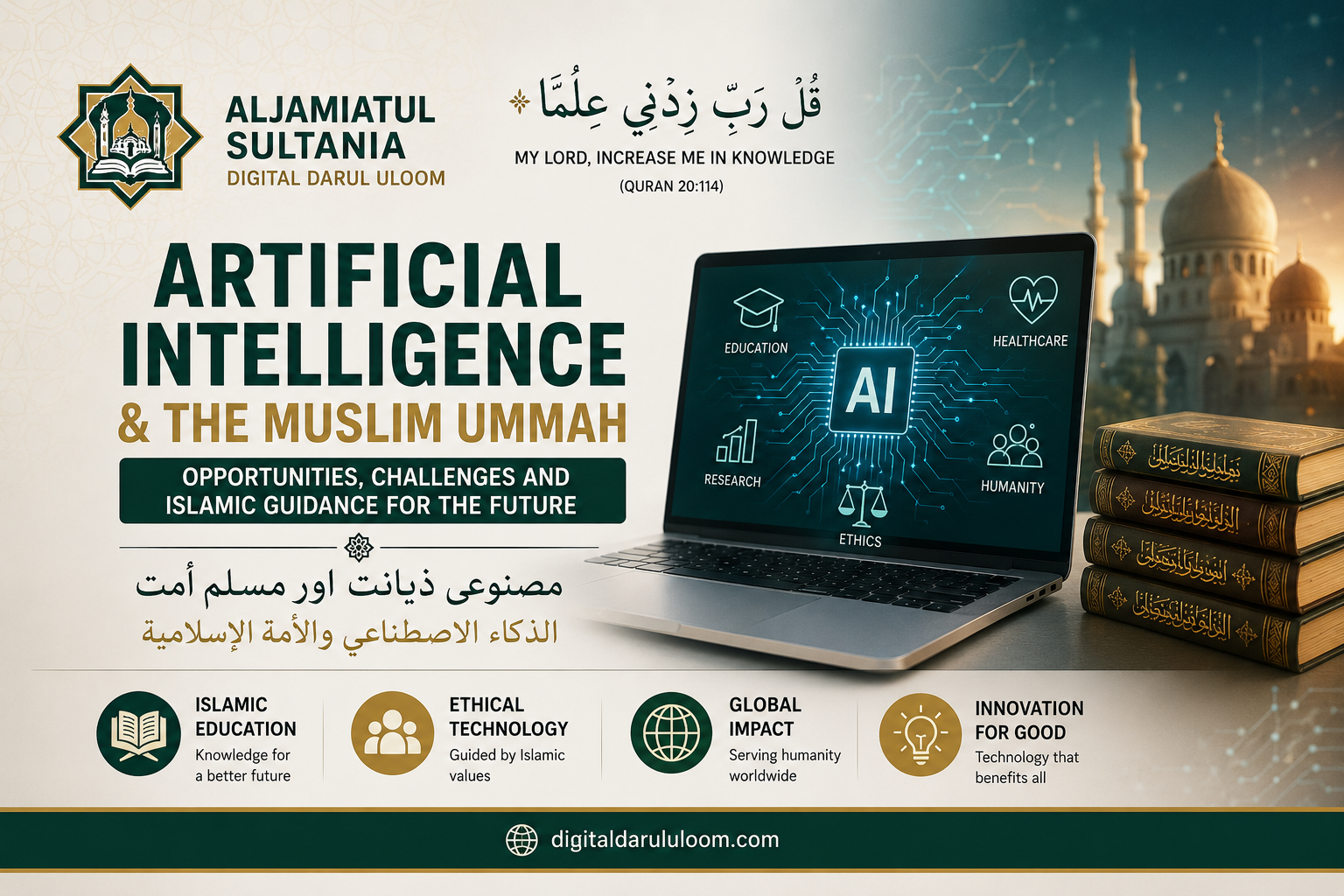
Artificial Intelligence and the Muslim Ummah | Islamic Perspective on AI
Introduction
Human civilization is entering a new technological era driven by Artificial Intelligence (AI). From education and healthcare to business and communication, AI is transforming the way people live and work. While many view AI simply as a technological advancement, Muslims must evaluate it through the lens of Islamic principles and ethics.
The question is not whether AI will shape the future—it already is. The real question is how the Muslim Ummah can use this powerful technology in a way that benefits humanity while remaining faithful to the teachings of Islam.
What is Artificial Intelligence?
Artificial Intelligence refers to computer systems capable of performing tasks that normally require human intelligence. These include:
- Language understanding
- Image recognition
- Data analysis
- Decision support
- Educational assistance
- Research and innovation
Modern AI systems can process vast amounts of information within seconds, making them valuable tools for learning and productivity.
The Islamic View of Knowledge and Technology
Islam has always encouraged the pursuit of beneficial knowledge.
Allah Almighty says:
“And say: My Lord, increase me in knowledge.”
(Surah Taha 20:114)
Throughout Islamic history, Muslim scholars pioneered advancements in mathematics, astronomy, medicine, engineering, and philosophy. The Islamic Golden Age demonstrates that faith and scientific progress can work together for the betterment of society.
Technology itself is neither good nor evil. Its value depends upon how it is used.
Opportunities for the Muslim Ummah
1. Islamic Education
AI can help students:
- Learn Quran and Tajweed
- Access authentic Islamic resources
- Study Arabic language
- Organize research efficiently
Digital platforms can make Islamic education accessible to Muslims worldwide.
2. Research and Knowledge Preservation
Thousands of classical Islamic manuscripts remain difficult to access. AI can assist scholars in:
- Digitizing manuscripts
- Translating texts
- Indexing historical works
- Preserving Islamic heritage
3. Healthcare and Humanitarian Service
AI contributes to:
- Medical diagnosis
- Disease prediction
- Healthcare accessibility
- Disaster response
Serving humanity is among the noble objectives encouraged by Islam.
4. Economic Development
AI can help Muslim entrepreneurs:
- Improve business efficiency
- Create new industries
- Develop ethical technology solutions
- Generate employment opportunities
Challenges and Ethical Concerns
While AI offers significant benefits, it also presents serious challenges.
Misinformation
AI can generate inaccurate or misleading content. Muslims must verify information before sharing it.
Privacy
Islam values the protection of personal information and human dignity. AI systems should respect privacy and confidentiality.
Bias and Injustice
Algorithms can produce unfair outcomes if designed improperly. Justice remains a fundamental Islamic principle.
Dependency
Technology should assist human beings, not replace critical thinking, wisdom, and moral responsibility.
Islamic Principles for Responsible AI
Muslim scholars, educators, and developers should ensure AI aligns with:
Truthfulness (Sidq)
Technology should promote accurate information and honesty.
Justice (Adl)
AI systems must avoid discrimination and oppression.
Public Benefit (Maslahah)
Technology should serve humanity and improve society.
Accountability (Amanah)
Developers and users remain responsible for how technology is applied.
The Role of Islamic Educational Institutions
Islamic institutions must prepare students for both religious and technological challenges.
Future Muslim leaders should be:
- Strong in Aqeedah
- Knowledgeable in Quran and Sunnah
- Skilled in technology
- Capable of ethical leadership
The world needs scholars who understand both Islamic tradition and emerging technologies.
Conclusion
Artificial Intelligence is one of the most powerful tools ever created by humanity. For the Muslim Ummah, it represents both an opportunity and a responsibility.
If guided by Islamic ethics, AI can support education, research, healthcare, and social development. However, without moral guidance, technology may create new forms of injustice and confusion.
The future belongs not merely to those who possess technology, but to those who use it with wisdom, integrity, and faith.
May Allah grant the Muslim Ummah beneficial knowledge, righteous action, and the ability to use modern technology for the service of humanity.
Ameen.



Al Jamiatul Sultania Digital Darul Uloom is a global Islamic education platform combining authentic Islamic scholarship with modern digital education. We provide free, certified courses in Quran Studies, Arabic Language, Islamic Finance, AI and emerging technologies — empowering Muslims worldwide.

 Website