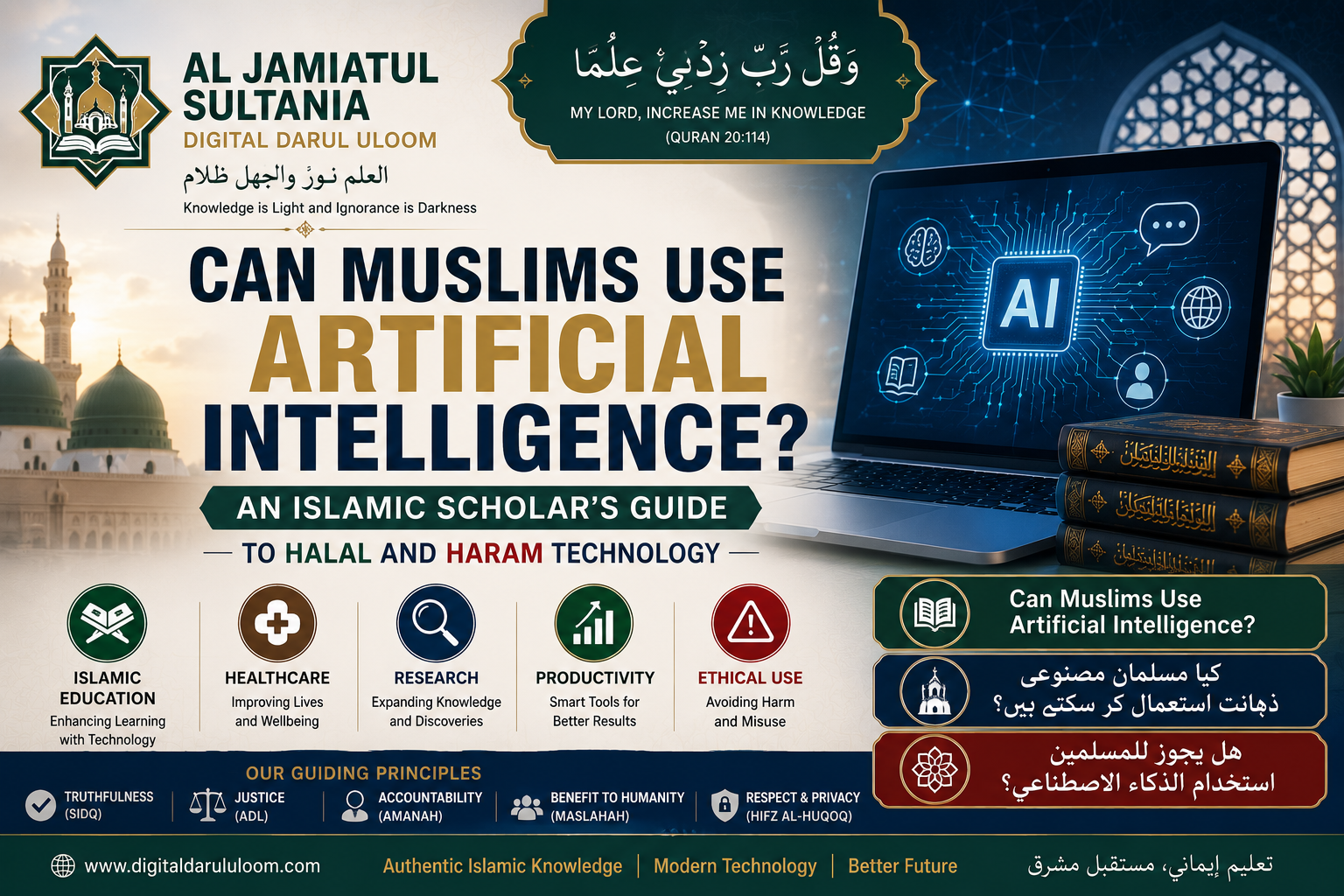
Can Muslims Use Artificial Intelligence? An Islamic Scholar’s Guide
Introduction
Artificial Intelligence (AI) has become one of the most influential technologies of our time. From education and healthcare to business and communication, AI is transforming the way people learn, work, and interact.
Many Muslims are asking important questions:
- Is Artificial Intelligence permissible in Islam?
- Can Muslims use AI tools such as ChatGPT?
- Are there Islamic guidelines for using modern technology?
- What is the difference between halal and haram uses of AI?
To answer these questions, we must turn to the principles of the Qur’an, Sunnah, and the teachings of Islamic scholars.
Islam Encourages Beneficial Knowledge
Allah Almighty says:
“And say: My Lord, increase me in knowledge.”
(Surah Taha 20:114)
The Messenger of Allah ﷺ said:
“Seeking knowledge is obligatory upon every Muslim.”
(Sunan Ibn Majah)
Throughout history, Muslims have contributed significantly to science, medicine, mathematics, astronomy, and education. Islam does not oppose technology; rather, it encourages beneficial knowledge that serves humanity and pleases Allah.
The Islamic Principle Regarding Technology
Islamic jurists established an important principle:
الأصل في الأشياء الإباحة
“The original ruling regarding worldly matters is permissibility.”
This means that new inventions, tools, and technologies are generally permissible unless they clearly involve something prohibited by Islamic law.
Therefore, Artificial Intelligence itself is neither halal nor haram by nature. Its ruling depends upon how it is used.
Beneficial Uses of Artificial Intelligence
1. Islamic Education
AI can assist students in:
- Learning Arabic
- Understanding Islamic terminology
- Organizing research
- Accessing educational resources
- Studying Islamic history
However, Islamic rulings should always be verified through qualified scholars and authentic sources.
2. Healthcare
AI assists doctors in:
- Medical diagnosis
- Disease prediction
- Patient care
- Research and treatment development
Protecting human life is one of the major objectives of Islamic law.
3. Research and Learning
Researchers can use AI to:
- Analyze large volumes of information
- Organize data
- Summarize research
- Improve productivity
Used correctly, AI can become a valuable educational assistant.
4. Serving Humanity
The Prophet ﷺ said:
“The most beloved people to Allah are those who are most beneficial to people.”
(Al-Mu’jam al-Awsat)
Any technology that benefits humanity and remains within Islamic boundaries can be a means of reward.
When AI Can Become Haram
Technology becomes prohibited when it is used for prohibited purposes.
1. Spreading False Information
Allah says:
“And do not pursue that of which you have no knowledge.”
(Surah Al-Isra 17:36)
Using AI to spread rumors, misinformation, or fabricated religious rulings is sinful.
2. Deception and Fraud
Using AI for:
- Scams
- Fake identities
- Financial fraud
- Academic cheating
is clearly prohibited in Islam.
The Prophet ﷺ said:
“Whoever deceives us is not one of us.”
(Sahih Muslim)
3. Producing Haram Content
AI must not be used to generate:
- Obscene material
- Gambling promotion
- Fraudulent content
- Content attacking Islam
A Muslim remains accountable for everything he creates and shares.
4. Violating Rights of Others
Islam teaches respect for:
- Privacy
- Trust
- Intellectual property
- Human dignity
AI should never be used to harm others or violate their rights.
Guidelines for Muslims Using AI
Verify Information
Never accept AI-generated content blindly, especially in matters of religion.
Consult Qualified Scholars
Islamic rulings should be taken from reliable scholars and authentic sources.
Use Technology for Good
Ask yourself:
- Does this benefit people?
- Does it bring me closer to Allah?
- Does it uphold honesty and integrity?
Maintain Islamic Ethics
Technology changes, but Islamic values remain constant:
- Truthfulness (Sidq)
- Trustworthiness (Amanah)
- Justice (Adl)
- Wisdom (Hikmah)
The Future of Muslims and Technology
The Muslim Ummah should not merely consume technology; it should contribute to its development.
Future Muslim scholars, engineers, educators, and entrepreneurs should work together to create ethical technologies guided by Islamic values.
The world needs experts who combine:
- Islamic scholarship
- Technical expertise
- Moral leadership
This balanced approach reflects the legacy of the great scholars of Islamic civilization.
Conclusion
Artificial Intelligence is a tool. Like any tool, its ruling depends upon how it is used.
When AI is used for education, healthcare, research, and beneficial purposes, it can be a blessing. When it is used for deception, immorality, or injustice, it becomes harmful and sinful.
Muslims should embrace beneficial technology while remaining firmly connected to the guidance of the Qur’an and Sunnah.
May Allah grant us beneficial knowledge, righteous action, and wisdom in using modern technology for the service of humanity.
Ameen.
References
- The Holy Qur’an – Surah Taha (20:114)
- The Holy Qur’an – Surah Al-Isra (17:36)
- Sahih Muslim – Hadith on deception
- Sunan Ibn Majah – Seeking knowledge
- Al-Mu’jam al-Awsat – Benefit to humanity
- Imam Al-Shatibi, Al-Muwafaqat (Objectives of Shariah)
- Imam Al-Suyuti, Al-Ashbah wa Al-Naza’ir (Legal Maxims)



Al Jamiatul Sultania Digital Darul Uloom is a global Islamic education platform combining authentic Islamic scholarship with modern digital education. We provide free, certified courses in Quran Studies, Arabic Language, Islamic Finance, AI and emerging technologies — empowering Muslims worldwide.

 Website