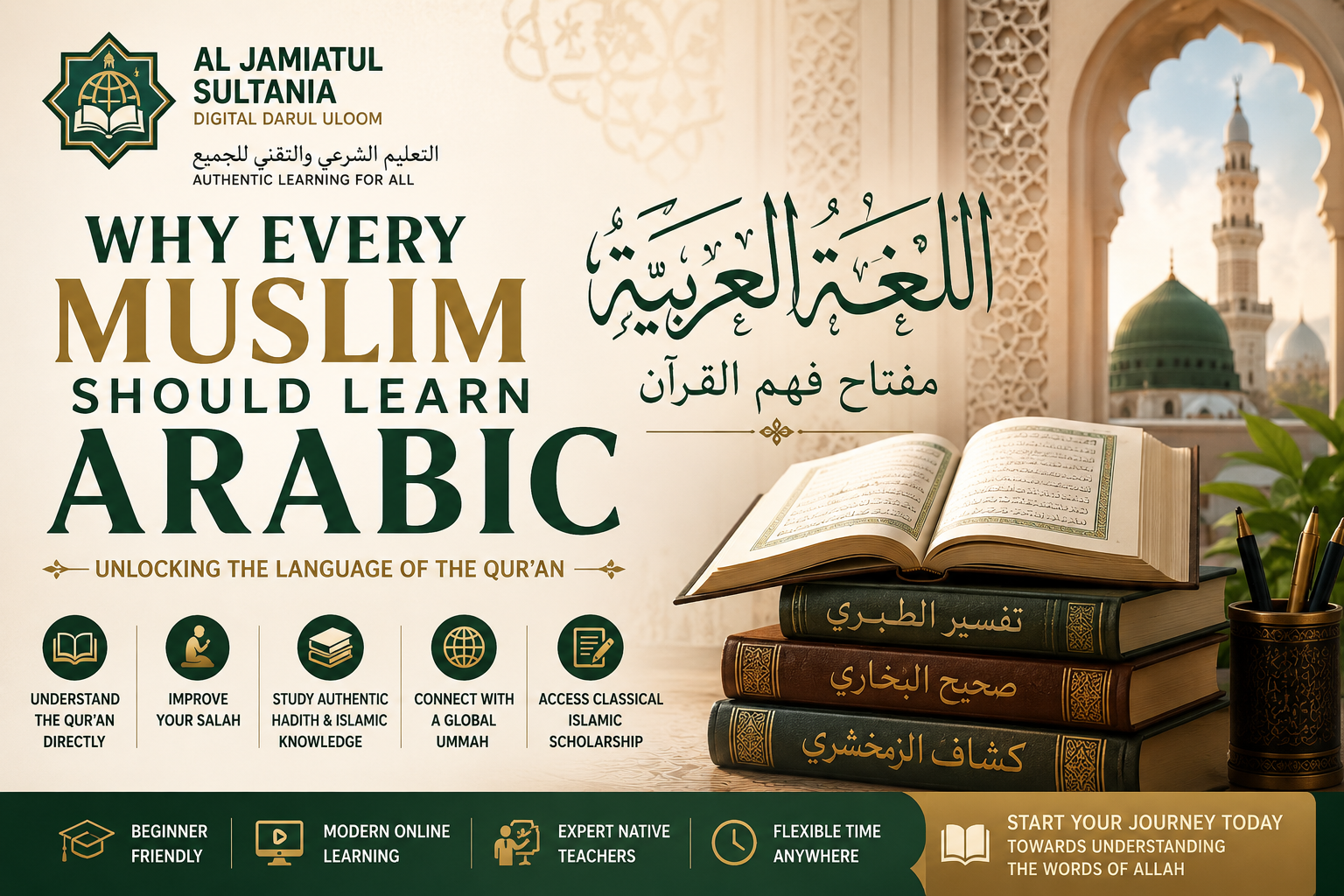
“Indeed, We have sent it down as an Arabic Qur’an so that you may understand.”
— Surah Yusuf (12:2)
The Arabic language occupies a unique and honored place in Islam. It is the language chosen by Allah ﷻ for the revelation of the Holy Qur’an and the language spoken by Prophet Muhammad ﷺ. For over fourteen centuries, Arabic has preserved the divine message of Islam, enabling Muslims across generations to recite, study, and understand the words of Allah.
Today, more than a billion Muslims recite verses from the Qur’an every day. Yet many do not fully understand the meanings of the words they recite. Learning Arabic opens the door to a deeper relationship with the Qur’an, enhances worship, and connects believers with centuries of authentic Islamic scholarship.
Arabic: The Language of Divine Revelation
Allah سبحانه وتعالى chose Arabic for His final revelation because of its precision, richness, and expressive beauty.
The Qur’an states:
“Indeed, We have sent it down as an Arabic Qur’an so that you may understand.”
(Surah Yusuf 12:2)
Understanding Arabic allows Muslims to appreciate the subtleties of the Qur’an that are often difficult to convey fully through translation.
Why Arabic Matters for Every Muslim
1. Understand the Qur’an Directly
Translations are valuable, but they cannot fully capture every nuance of the original Arabic. By learning Arabic, Muslims can engage directly with Allah’s words and discover deeper meanings.
2. Improve the Quality of Salah
Every Muslim recites Surah Al-Fatihah and other verses during prayer. Understanding their meanings transforms prayer from a routine act into a heartfelt conversation with Allah.
3. Understand Authentic Hadith
The sayings of Prophet Muhammad ﷺ were preserved in Arabic. Learning the language enables students to appreciate the original expressions and meanings found in authentic Hadith collections.
4. Access Classical Islamic Scholarship
Thousands of important Islamic works remain in Arabic, including books on:
- Tafsir
- Hadith
- Aqeedah
- Fiqh
- Seerah
- Islamic History
- Arabic Literature
Learning Arabic grants direct access to this rich intellectual heritage.
5. Strengthen Islamic Identity
Arabic unites Muslims across cultures and nations. Whether in prayer, Hajj, or Islamic learning, it serves as a common language connecting the global Ummah.
Common Misconceptions About Learning Arabic
“Arabic is too difficult.”
Every language requires dedication, but modern teaching methods make Arabic much more accessible than ever before.
“I’m too old to start.”
Learning has no age limit. Many adults successfully begin studying Arabic later in life.
“Only scholars need Arabic.”
Every Muslim benefits from understanding the language of the Qur’an, even at a basic level.
Modern Technology Makes Learning Easier
Today’s learners have access to:
- Live online classes
- Interactive lessons
- Digital flashcards
- Mobile learning apps
- AI-assisted pronunciation practice
- Virtual classrooms
- Recorded lectures
- Online quizzes
These tools allow students to learn from anywhere in the world at their own pace.
A Simple Roadmap for Beginners
Step 1: Learn the Arabic Alphabet
Master the letters and their pronunciation.
Step 2: Build Everyday Vocabulary
Learn common Qur’anic words and phrases.
Step 3: Study Basic Grammar
Understand sentence structure, nouns, verbs, and simple rules.
Step 4: Read Short Qur’anic Chapters
Practice reading and understanding familiar surahs.
Step 5: Continue with Regular Practice
Consistency is more important than speed. Even 20–30 minutes of daily study can lead to steady progress.
Benefits Beyond Religious Knowledge
Learning Arabic also provides practical advantages:
- Better communication in Arabic-speaking countries
- Opportunities in education and research
- Careers in translation and interpretation
- Access to a vast collection of historical and academic resources
- Enhanced cognitive and language-learning skills
Frequently Asked Questions
Can I learn Arabic without living in an Arab country?
Yes. Modern online education has made Arabic learning accessible worldwide.
How long does it take?
Basic reading skills can often be developed within a few months of consistent study. Achieving fluency depends on the learner’s dedication and practice.
Should I learn Modern Standard Arabic or Qur’anic Arabic?
For Muslims whose primary goal is understanding the Qur’an and classical Islamic texts, beginning with Qur’anic Arabic is often the most beneficial approach.
Conclusion
Learning Arabic is not merely about acquiring a new language—it is about opening a door to a deeper understanding of Islam. It enables Muslims to engage directly with the Qur’an, appreciate the teachings of the Prophet ﷺ, and access centuries of authentic Islamic scholarship.
With dedication, sincere intention, and consistent effort, every Muslim can begin this rewarding journey.
As Allah says:
“And say: My Lord, increase me in knowledge.”
(Surah Taha 20:114)
May Allah ﷻ grant us beneficial knowledge, sincerity in learning, and the ability to act upon what we learn. Ameen.


Al Jamiatul Sultania Digital Darul Uloom is a global Islamic education platform combining authentic Islamic scholarship with modern digital education. We provide free, certified courses in Quran Studies, Arabic Language, Islamic Finance, AI and emerging technologies — empowering Muslims worldwide.

 Website