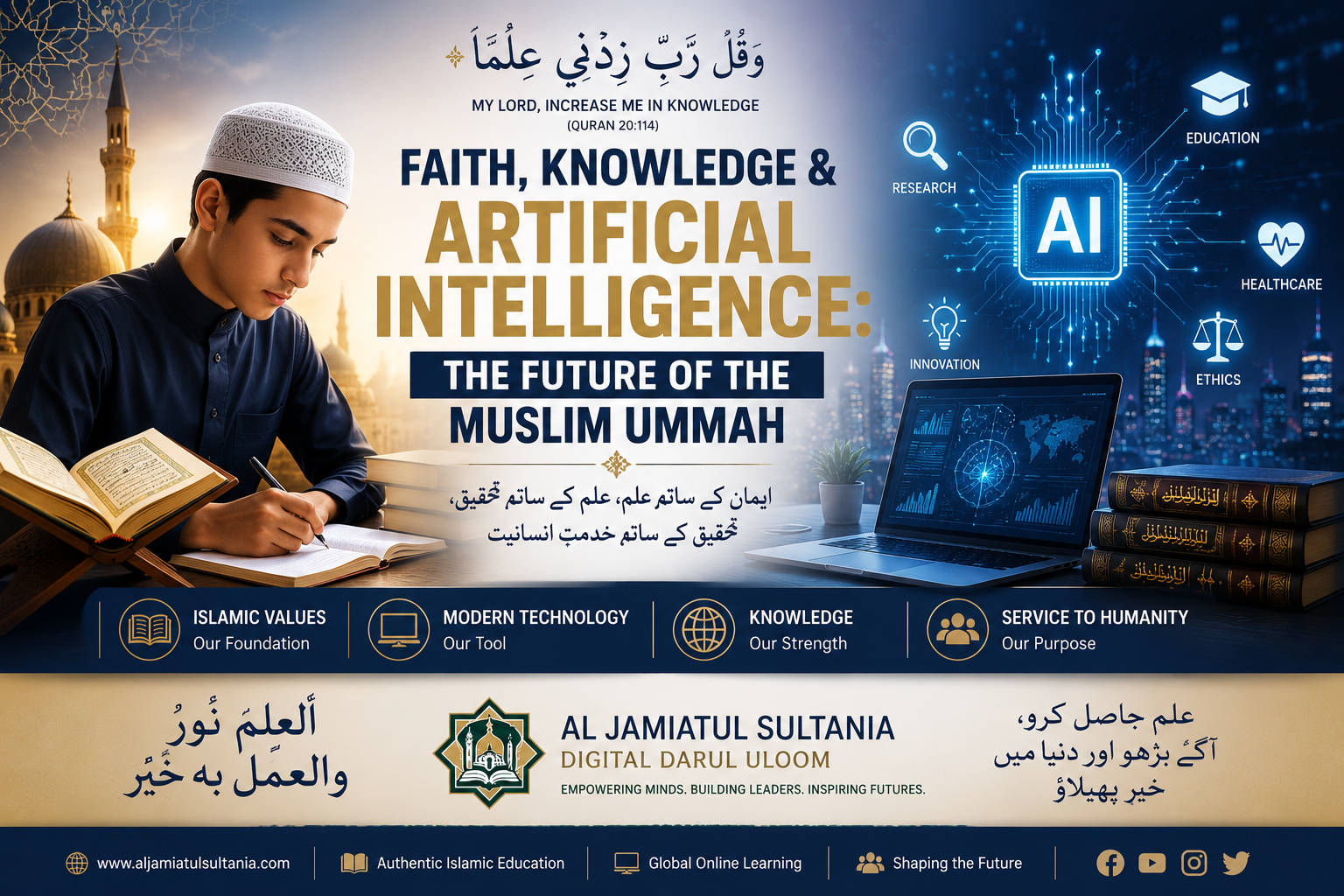
The Defining Question of Our Generation
Artificial Intelligence is transforming the world at an unprecedented pace. From education and healthcare to finance and communication, AI is reshaping how humanity learns, works, and lives.
Yet a critical question confronts the Muslim Ummah:
Can Muslims embrace technological advancement while remaining firmly rooted in Islamic values?
Some fear technology will weaken faith. Others believe Muslims should simply consume innovations created by others. However, Islamic history teaches a different lesson.
The Muslim Ummah has never been called to stand on the sidelines of human progress. Rather, Islam encourages beneficial knowledge, innovation, and excellence while maintaining moral responsibility before Allah.
The challenge is not whether Muslims should participate in the AI revolution. The challenge is whether Muslims will lead it with wisdom, ethics, and faith.
Islam Encourages Beneficial Knowledge
The first revelation to Prophet Muhammad ﷺ began with a command:
“Read in the name of your Lord who created.”
This command established knowledge as a foundation of Islamic civilization.
Throughout history, Muslim scholars contributed to mathematics, astronomy, medicine, engineering, architecture, and philosophy. They did not see faith and knowledge as opposing forces. They viewed knowledge as a trust and a means of serving humanity.
Today, artificial intelligence represents a new frontier of knowledge. Muslims should approach it with curiosity, responsibility, and confidence.
Technology Is a Tool, Not a Religion
Technology itself is neither Islamic nor un-Islamic.
Its value depends on how it is used.
A smartphone can spread Quranic knowledge or harmful content.
Artificial intelligence can assist education, research, healthcare, and humanitarian efforts—or it can be misused.
Islam teaches that tools must be guided by ethics.
The question is not whether AI is powerful.
The question is whether its power will be directed toward justice, compassion, truth, and human dignity.
Why the Muslim Ummah Must Participate
If Muslims withdraw from emerging technologies, they risk becoming dependent on others for systems that influence education, communication, economics, and culture.
Future generations need Muslim:
- Software engineers
- AI researchers
- Cybersecurity experts
- Data scientists
- Educators
- Ethical technology leaders
The Ummah must not only consume technology; it must help shape its future.
Islamic Ethics in the Age of Artificial Intelligence
AI development requires more than technical expertise.
It requires moral guidance.
Islam offers principles that are increasingly important in a world driven by algorithms:
- Truthfulness
- Accountability
- Justice
- Protection of privacy
- Human dignity
- Responsible use of knowledge
These principles can help ensure that technological advancement benefits humanity rather than harms it.
Building the Next Generation of Muslim Innovators
The future belongs to students who combine:
- Strong Islamic character
- Deep knowledge of the Quran and Sunnah
- Digital literacy
- Critical thinking
- Scientific understanding
- Leadership skills
Muslim youth should not be forced to choose between faith and innovation.
They should be equipped to excel in both.
A Call to the Ummah
The AI revolution is not merely a technological challenge.
It is an educational challenge.
It is a moral challenge.
It is a leadership challenge.
The Muslim Ummah possesses a rich intellectual heritage and timeless ethical guidance. By combining authentic Islamic scholarship with modern technological education, we can prepare a generation capable of contributing positively to the world.
The future should not be shaped only by machines.
It should be shaped by people of knowledge, wisdom, and faith.
And perhaps the next great innovators, educators, and ethical technology leaders will emerge from institutions dedicated to both Islamic scholarship and modern learning.
The responsibility begins today.


Al Jamiatul Sultania Digital Darul Uloom is a global Islamic education platform combining authentic Islamic scholarship with modern digital education. We provide free, certified courses in Quran Studies, Arabic Language, Islamic Finance, AI and emerging technologies — empowering Muslims worldwide.
 Website