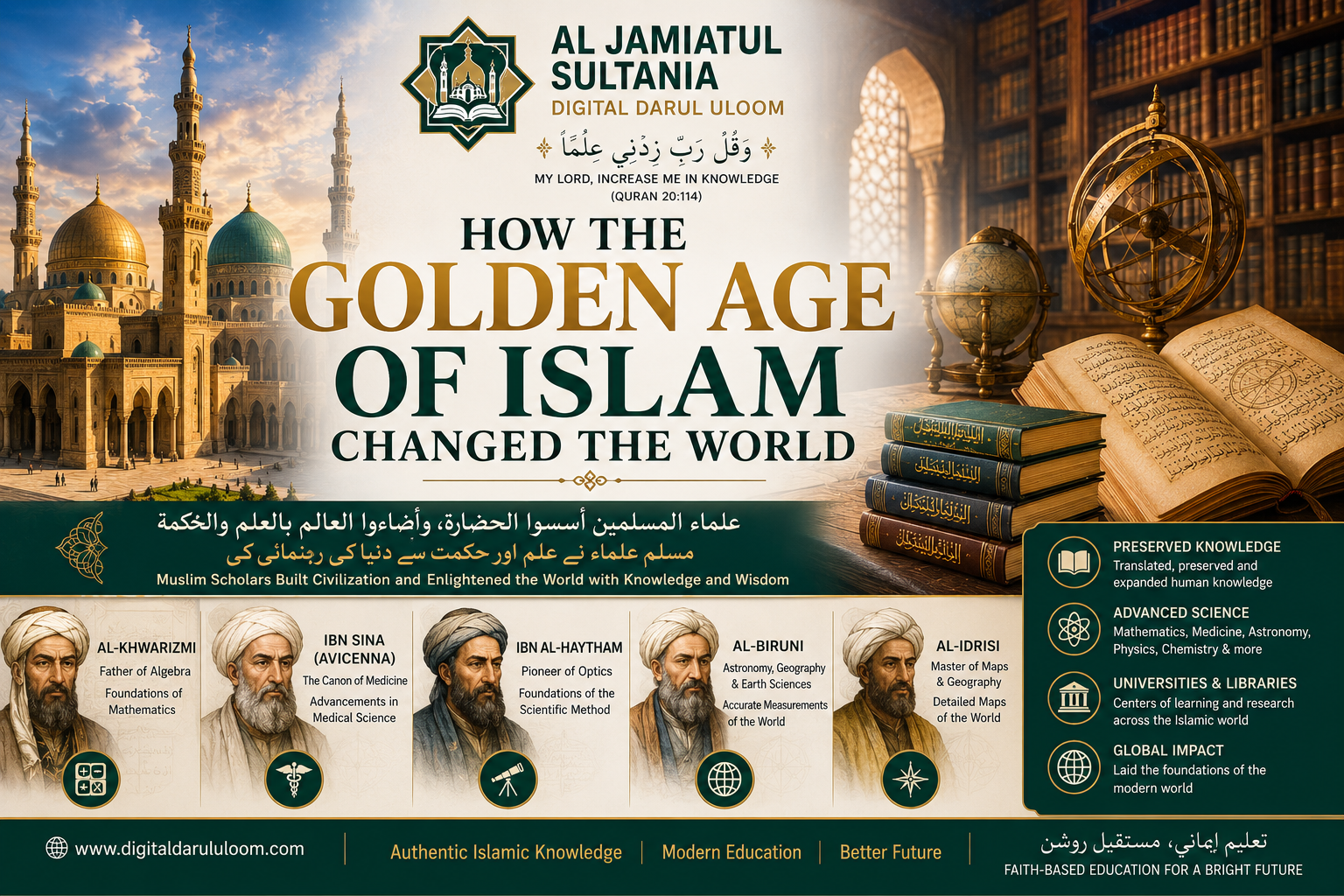
Discover how Muslim scholars transformed mathematics, medicine, astronomy, geography, and science during the Golden Age of Islam and shaped the modern world.
Introduction
When many people think about the advancement of science, medicine, mathematics, and technology, they often overlook one of the most remarkable periods in human history—the Golden Age of Islam.
From the 8th to the 14th century, Muslim scholars led the world in scientific discovery, education, medicine, astronomy, mathematics, architecture, and philosophy. During a time when much of the world struggled with limited access to knowledge, Islamic civilization became a beacon of learning and innovation.
The achievements of Muslim scholars not only transformed their own societies but also laid the foundations for many aspects of the modern world.
What Was the Golden Age of Islam?
The Golden Age of Islam generally refers to the period between the 8th and 14th centuries CE, particularly during the Abbasid Caliphate.
Major centers of learning included:
- Baghdad
- Damascus
- Cairo
- Cordoba
- Samarkand
- Bukhara
Libraries, observatories, hospitals, and universities flourished throughout the Muslim world.
Knowledge from various civilizations was translated into Arabic, preserved, improved, and expanded by Muslim scholars.
Islam’s Encouragement of Knowledge
The pursuit of knowledge is deeply rooted in Islam.
Allah Almighty says:
“Read in the name of your Lord who created.”
(Surah Al-‘Alaq 96:1)
Allah also says:
“Are those who know equal to those who do not know?”
(Surah Az-Zumar 39:9)
The Prophet Muhammad ﷺ said:
“Seeking knowledge is obligatory upon every Muslim.”
(Sunan Ibn Majah)
These teachings inspired generations of Muslims to pursue learning and intellectual excellence.
The House of Wisdom in Baghdad
One of the most famous institutions of the Islamic world was the Bayt al-Hikmah (House of Wisdom) in Baghdad.
It served as:
- A library
- Research center
- Translation institute
- Scientific academy
Scholars translated and studied works from Greek, Persian, Indian, and other civilizations while making original contributions of their own.
This institution became one of the greatest centers of knowledge in human history.
Muslim Contributions to Mathematics
Al-Khwarizmi (780–850 CE)
Muhammad ibn Musa al-Khwarizmi is often called the “Father of Algebra.”
His work:
Kitab al-Jabr wa al-Muqabala
introduced systematic methods for solving equations.
The English word “Algebra” comes from “Al-Jabr.”
The word “Algorithm” is derived from the Latinized form of Al-Khwarizmi’s name.
Without his contributions, modern computing and computer science would be unimaginable.
Muslim Contributions to Medicine
Ibn Sina (Avicenna)
Abu Ali al-Husayn ibn Sina authored:
Al-Qanun fi al-Tibb (The Canon of Medicine)
This medical encyclopedia became one of the most influential medical texts in the world and was used in European universities for centuries.
His work covered:
- Diagnosis
- Pharmacology
- Surgery
- Disease prevention
- Medical ethics
Muslim Contributions to Optics
Ibn al-Haytham
Known in the West as Alhazen, Ibn al-Haytham revolutionized the study of optics.
His major work:
Kitab al-Manazir (Book of Optics)
established scientific methods based on observation and experimentation.
Many historians regard him as one of the pioneers of the modern scientific method.
Muslim Contributions to Astronomy
Muslim astronomers:
- Calculated planetary movements
- Improved astronomical instruments
- Developed observatories
- Produced detailed star catalogues
Their work influenced later European scientists and navigators.
Important scholars included:
- Al-Battani
- Al-Biruni
- Nasir al-Din al-Tusi
Muslim Contributions to Geography
Al-Idrisi
Al-Idrisi produced some of the most accurate maps of the medieval world.
His geographical works helped improve understanding of:
- Trade routes
- Continents
- Oceans
- Civilizations
His maps remained valuable references for centuries.
Universities and Libraries
Long before many modern universities existed, the Muslim world established institutions of higher learning.
Examples include:
- Al-Qarawiyyin (Morocco)
- Al-Azhar (Egypt)
Thousands of books were collected in vast libraries across the Islamic world.
These institutions promoted learning for scholars from diverse backgrounds.
The Influence on Europe
Many scientific works of Muslim scholars were translated into Latin.
European scholars studied these texts extensively during the Renaissance.
Fields influenced by Muslim scholarship include:
- Mathematics
- Medicine
- Astronomy
- Chemistry
- Engineering
- Philosophy
Historians widely acknowledge that the preservation and advancement of knowledge by Muslim scholars played a significant role in the development of modern civilization.
Lessons for Today’s Muslim Youth
The Golden Age of Islam teaches us that:
Faith and Knowledge Go Together
Islam encourages both spiritual growth and intellectual excellence.
Muslims Should Lead in Innovation
The early Muslim scholars were not passive consumers of knowledge; they were creators and innovators.
Education Is a Sacred Responsibility
The pursuit of beneficial knowledge remains one of the greatest acts of worship.
Technology Must Be Guided by Ethics
Scientific progress should always serve humanity and uphold moral values.
Reviving the Legacy
The Muslim Ummah possesses a rich intellectual heritage.
By combining:
- Quranic guidance
- Authentic Islamic scholarship
- Modern education
- Emerging technologies
Muslims can once again contribute positively to humanity.
Institutions such as digital Islamic academies and online Darul Ulooms have an important role in preparing future generations of scholars, educators, researchers, and innovators.
Conclusion
The Golden Age of Islam was not merely a historical period; it was a powerful demonstration of what can happen when faith, knowledge, and dedication come together.
The contributions of Muslim scholars shaped mathematics, medicine, astronomy, geography, and countless other fields that continue to benefit humanity today.
As Muslims face the challenges and opportunities of the modern world, the legacy of the Golden Age serves as a reminder that Islam encourages excellence, innovation, and service to humanity.
May Allah inspire the Muslim Ummah to revive the spirit of learning, discovery, and beneficial knowledge.
Ameen.
References
Primary Islamic Sources
- The Holy Qur’an – Surah Al-‘Alaq (96:1-5)
- The Holy Qur’an – Surah Az-Zumar (39:9)
- Sunan Ibn Majah – Book of Knowledge
Historical References
- George Saliba, Islamic Science and the Making of the European Renaissance
- Jonathan Lyons, The House of Wisdom
- Jim Al-Khalili, Pathfinders: The Golden Age of Arabic Science
- Seyyed Hossein Nasr, Science and Civilization in Islam
- Ibn Abi Usaybi’ah, History of Physicians
- UNESCO Historical Studies on Islamic Civilization
- Encyclopedia of the History of Science, Technology and Medicine in Non-Western Cultures


Al Jamiatul Sultania Digital Darul Uloom is a global Islamic education platform combining authentic Islamic scholarship with modern digital education. We provide free, certified courses in Quran Studies, Arabic Language, Islamic Finance, AI and emerging technologies — empowering Muslims worldwide.

 Website